
 Wildlife
of Kenya
Grant's Gazelle
Antelopes & Other Bovids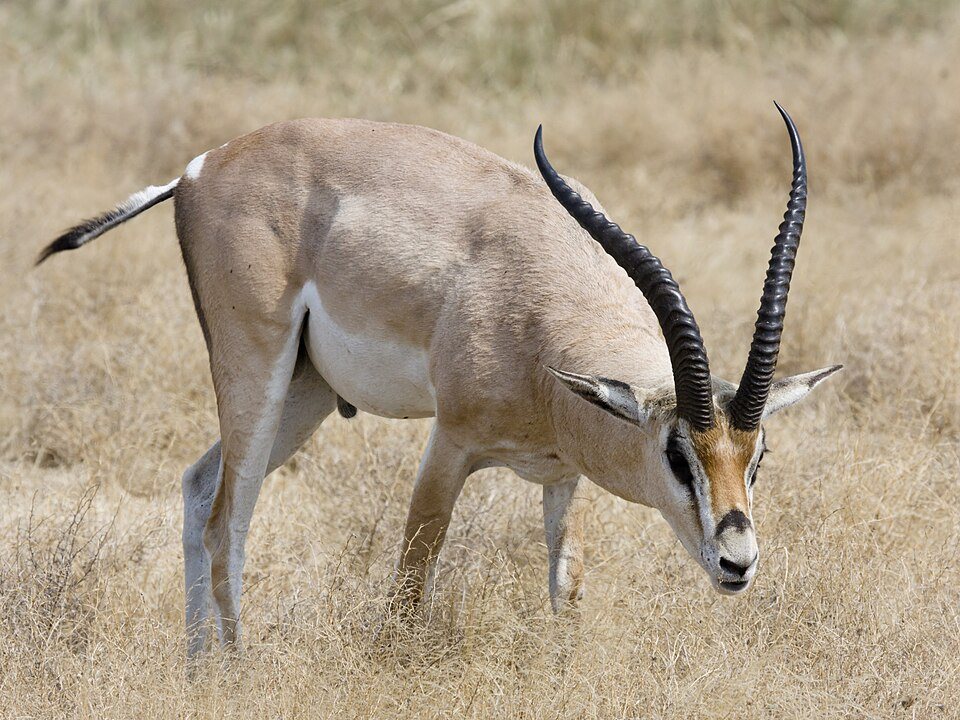
Photo: Ikiwaner · GFDL 1.2 (May be cropped or resized)
Nanger granti
Conservation status: Unknown
Basic stats
Diet
Grass; browse in dry seasons
Habitat
Short grassy plains, arid scrubland and semi-arid country
Range
East Africa: northern Tanzania to South Sudan and Ethiopia
Litter size
1 fawn
Gestation period
About 196 days (AnAge and COMBINE)
Size
Shoulder height 75–95cm
Weight
35–50kg (females), 50–80kg (males)
Grant's gazelle is a relatively large gazelle of East Africa, distributed from northern Tanzania to South Sudan and Ethiopia and from the Kenyan coast to Lake Victoria. It is named after the 19th-century Scottish explorer James Grant. It stands 75–95cm at the shoulder, with females weighing 35–50kg and males 50–80kg. The back is beige-orange and the belly white. It resembles Thomson's gazelle but is much larger and has stout lyre-shaped horns, clearly ringed and 45–81cm long. White on the rump that extends over the top of the tail is a useful field mark (Wikipedia, general species account).
Grant's gazelles live in small to mid-sized herds of females with young and bachelor groups, and males become territorial in the mating season. They prefer short grassy plains where they graze, but also browse in sparse arid scrub, and they avoid tall grass that hides predators. They are well adapted to dry areas and can live on vegetation where there is no water. Cheetahs and African wild dogs are the most common predators, with hyenas, leopards and lions also present (Wikipedia, general species account).
Where to see Grant's Gazelle in Kenya
GBIF records grouped by protected area. They show where the species has been reported, not that it is there now, and they are not population counts.
Recorded in 47 protected areas (1929–2026). The 8 with the most records:
- Shurr Community Conservancy: 343 records (2008–2012)
- Melako Community Conservancy: 312 records (2008–2012)
- Lake Nakuru National Park: 104 records (1989–2025)
- Nakuprat-Gotu Community Wildlife Conservancy: 78 records (1929–2019)
- Sera Community Conservancy: 67 records (2008–2012)
- Buffalo Springs National Reserve: 61 records (1985–2025)
- Ol Pejeta Conservancy: 45 records (2007–2026)
- Amboseli National Park: 43 records (1935–2026)
Quick answers
- What does the Grant's Gazelle eat?
- Grass; browse in dry seasons
- What habitat does the Grant's Gazelle live in?
- Short grassy plains, arid scrubland and semi-arid country
- Where is the Grant's Gazelle found?
- East Africa: northern Tanzania to South Sudan and Ethiopia
- What is the litter size of the Grant's Gazelle?
- 1 fawn
- How long is the gestation period of the Grant's Gazelle?
- About 196 days (AnAge and COMBINE)
- How big is the Grant's Gazelle?
- Shoulder height 75–95cm
- How much does the Grant's Gazelle weigh?
- 35–50kg (females), 50–80kg (males)