
 Wildlife
of Kenya
Hirola
Antelopes & Other Bovids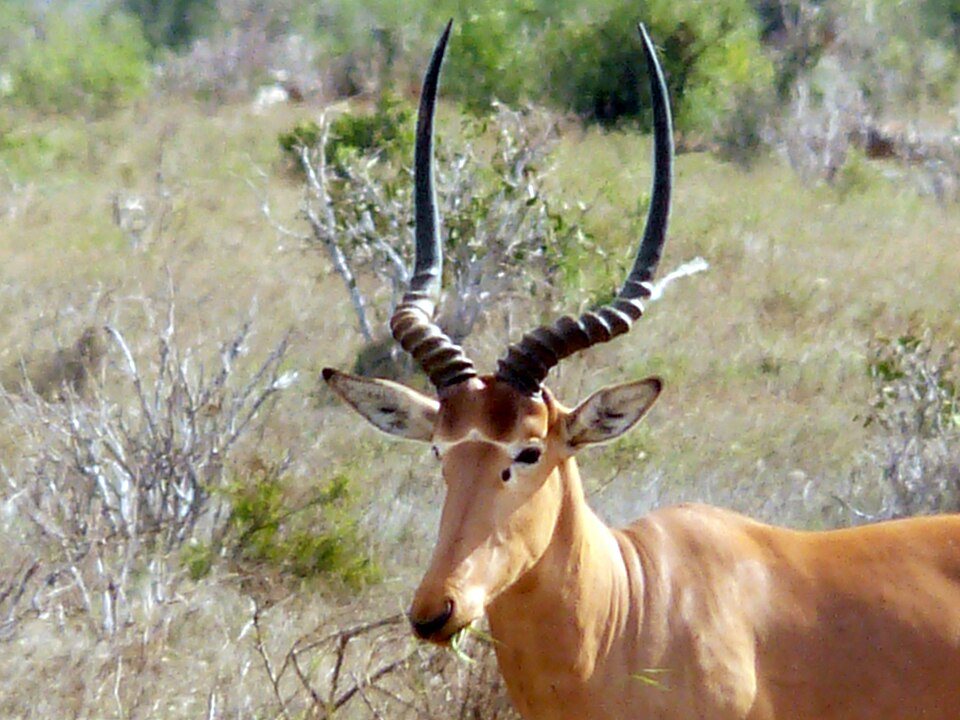
Photo: JRProbert · CC BY-SA 4.0 (May be cropped or resized)
Beatragus hunteri
Conservation status: Unknown
Basic stats
Diet
Green grasses
Habitat
Semi-arid shrubby grassland and wooded grassland
Range
Eastern Kenya and western Somalia, between the Tana and Juba rivers
Litter size
1 calf
Size
Head and body 164–200cm; shoulder height 95–125cm; tail 36–45cm
Weight
73–118kg
The hirola is a medium-sized antelope, smaller and lighter than a hartebeest and with a more horizontal back. The coat is tawny, often with rufous tones, darkening with age, and the underparts are whitish-tawny. The inner ears are white, as is most of the long tail. The slender, lyrate horns stand on no pedicle and measure 45–61cm in males and 35–50cm in females. Two partial white eye rings are joined by an inverted white chevron across the face, and large dark glands below the eyes give the species the name four-eyed antelope. Head and body measure 164–200cm and weight is 73–118kg (GBIF description, Bovidae; Wikipedia, general species account).
The natural habitat is semi-arid, with scattered shrubby grassland and wooded grassland. In Tsavo East National Park it has been introduced to fairly open short-grass habitat, and recruitment there has been low (GBIF description, Bovidae). The diet is mostly green grasses, with 24 plants recorded in Tsavo, 21 of them grasses, and the grasses it picks are cropped 5–9cm above ground. Social groups consist of one male with two to six adult females and their young, and some animals associate with Grant's gazelles or zebras. It ranged between the Tana and Juba rivers; Wikipedia places it now only in Kenya near the Somali border (GBIF description, Bovidae; Wikipedia, general species account).
Quick answers
- What does the Hirola eat?
- Green grasses
- What habitat does the Hirola live in?
- Semi-arid shrubby grassland and wooded grassland
- Where is the Hirola found?
- Eastern Kenya and western Somalia, between the Tana and Juba rivers
- What is the litter size of the Hirola?
- 1 calf
- How big is the Hirola?
- Head and body 164–200cm; shoulder height 95–125cm; tail 36–45cm
- How much does the Hirola weigh?
- 73–118kg