
 Wildlife
of Kenya
Hartebeest
Antelopes & Other Bovids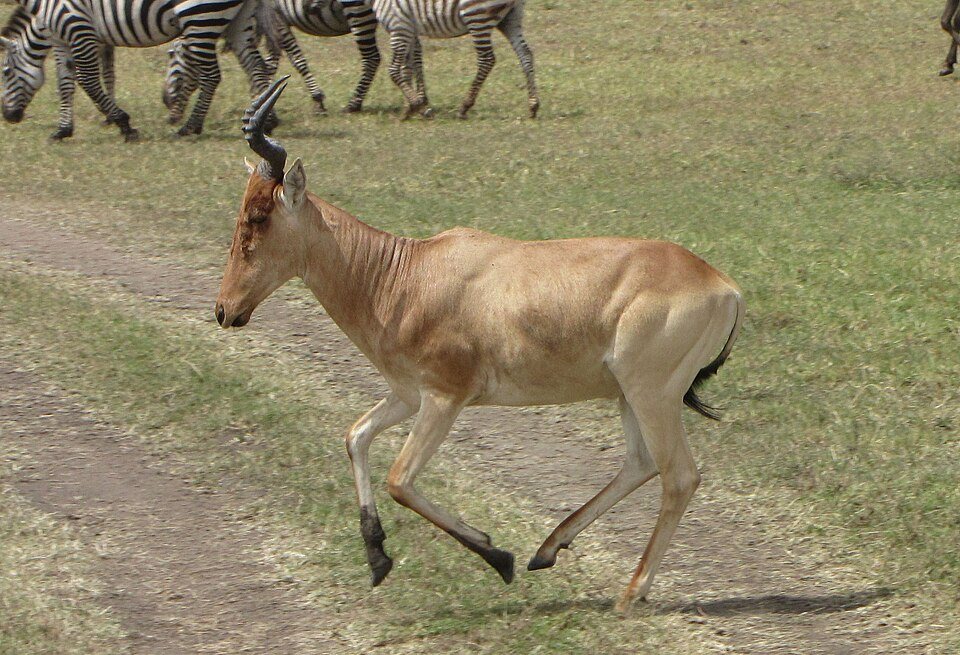
Photo: D. Gordon E. Robertson · CC BY-SA 3.0 (May be cropped or resized)
Alcelaphus buselaphus
Conservation status: Unknown
Basic stats
Diet
Mainly grasses
Habitat
Dry savannas and wooded grasslands
Range
Africa; extinct in several northern and southern countries
Litter size
1 calf
Gestation period
8–9 months
Size
Just over 1m at the shoulder; head and body 2–2.5m
Weight
100–200kg
The hartebeest is a large African antelope and the only member of its genus. It stands just over 1m at the shoulder and measures 2–2.5m in head and body, with a weight of 100–200kg. It has a long, narrow forehead, an oddly shaped pair of horns carried by both sexes, a short neck, pointed ears and long legs that often show black markings. Horns reach 45–70cm, and those of females are slenderer. A sloping back and a shoulder hump set it apart from other antelopes. The tail is 40–60cm long and ends in a black tuft. Coat colour runs from sandy brown to chocolate brown among eight described subspecies (Wikipedia, general species account).
Hartebeest are gregarious, forming herds of 20 to 300 that are alert and non-aggressive. They are mainly grazers. They live in dry savanna and wooded grassland and often shift to drier ground after rain, and they have been reported up to 4,000m on Mount Kenya. Mating happens year-round with one or two peaks, gestation lasts eight to nine months, and a single calf is born, with births usually peaking in the dry season. Wild lifespan is given as 12 to 15 years. The species is extinct in Algeria, Egypt, Lesotho, Libya, Morocco, Somalia and Tunisia, and introduced in Eswatini and Zimbabwe (Wikipedia, general species account).
Where to see Hartebeest in Kenya
GBIF records grouped by protected area. They show where the species has been reported, not that it is there now, and they are not population counts.
Recorded in 15 protected areas (1985–2026). The 8 with the most records:
- Chyulu Hills: 78 records (2015–2022)
- Masai Mara: 25 records (1985–2026)
- Nairobi National Park: 22 records (2006–2025)
- Tsavo West National Park: 22 records (2015–2024)
- Tsavo East National Park: 20 records (2003–2026)
- Lumo Conservancy: 14 records (2019)
- Mugie Conservancy;Mugie Wildlife Conservancy: 9 records (2008–2024)
- Mara Triangle: 6 records (2017–2024)
Quick answers
- What does the Hartebeest eat?
- Mainly grasses
- What habitat does the Hartebeest live in?
- Dry savannas and wooded grasslands
- Where is the Hartebeest found?
- Africa; extinct in several northern and southern countries
- What is the litter size of the Hartebeest?
- 1 calf
- How long is the gestation period of the Hartebeest?
- 8–9 months
- How big is the Hartebeest?
- Just over 1m at the shoulder; head and body 2–2.5m
- How much does the Hartebeest weigh?
- 100–200kg