
 Wildlife
of Kenya
Bongo
Antelopes & Other Bovids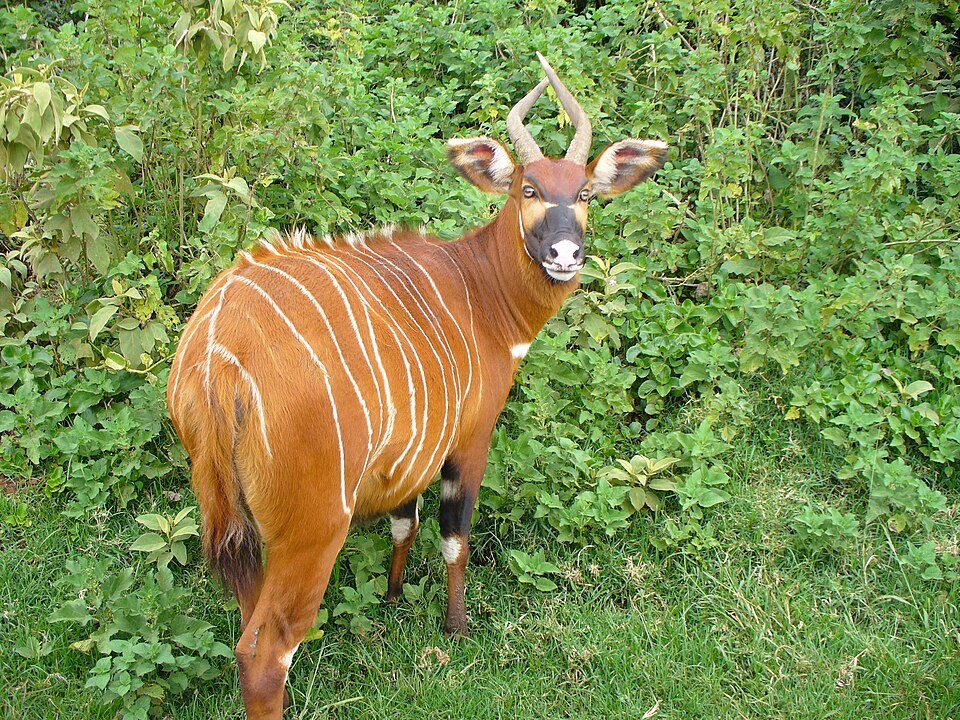
Photo: Chuckupd at English Wikipedia · Public domain
Tragelaphus eurycerus
Conservation status: Unknown
Basic stats
Diet
Plant material (EltonTraits)
Habitat
Lowland rainforest; montane forest at 2,100–3,000m in Kenya
Range
West and Central Africa, plus montane forest in Kenya
Litter size
1
Gestation period
About 288 days (AnAge, COMBINE)
Size
Shoulder height 1.1–1.3m; length 2.15–3.15m including tail
Weight
150–235kg (females), 220–405kg (males)
The bongo is a large forest antelope with a chestnut to auburn coat marked by 10–15 white-yellow vertical stripes, a short bristly dorsal ridge, and white chevrons on the face and chest. Adults stand 1.1–1.3m at the shoulder and measure 2.15–3.15m in length including the tail. Females weigh roughly 150–235kg and males 220–405kg. Both sexes carry heavy, slightly spiralled horns, longer and more massive in males. Male coats darken with age, and eastern bongos are darker than western ones (Wikipedia, general species account).
Bongos live mainly in disturbed lowland rainforest in West and Central Africa, while the remnant Kenyan populations occupy montane forest at 2,100–3,000m. Closed forest offers too little forage for such large animals, so they depend on forest openings and on mineral licks, which are focal points of social activity. They are reported to be mainly nocturnal, with activity peaks near dawn and dusk. Typical groups hold 2–8 animals, with up to 50 at some licks. Gestation lasts about 288 days and a single calf is born (GBIF description, Bovidae; AnAge; COMBINE).
Quick answers
- What does the Bongo eat?
- Plant material (EltonTraits)
- What habitat does the Bongo live in?
- Lowland rainforest; montane forest at 2,100–3,000m in Kenya
- Where is the Bongo found?
- West and Central Africa, plus montane forest in Kenya
- What is the litter size of the Bongo?
- 1
- How long is the gestation period of the Bongo?
- About 288 days (AnAge, COMBINE)
- How big is the Bongo?
- Shoulder height 1.1–1.3m; length 2.15–3.15m including tail
- How much does the Bongo weigh?
- 150–235kg (females), 220–405kg (males)