
 Wildlife
of Kenya
Grevy's Zebra
Zebras & Other Equids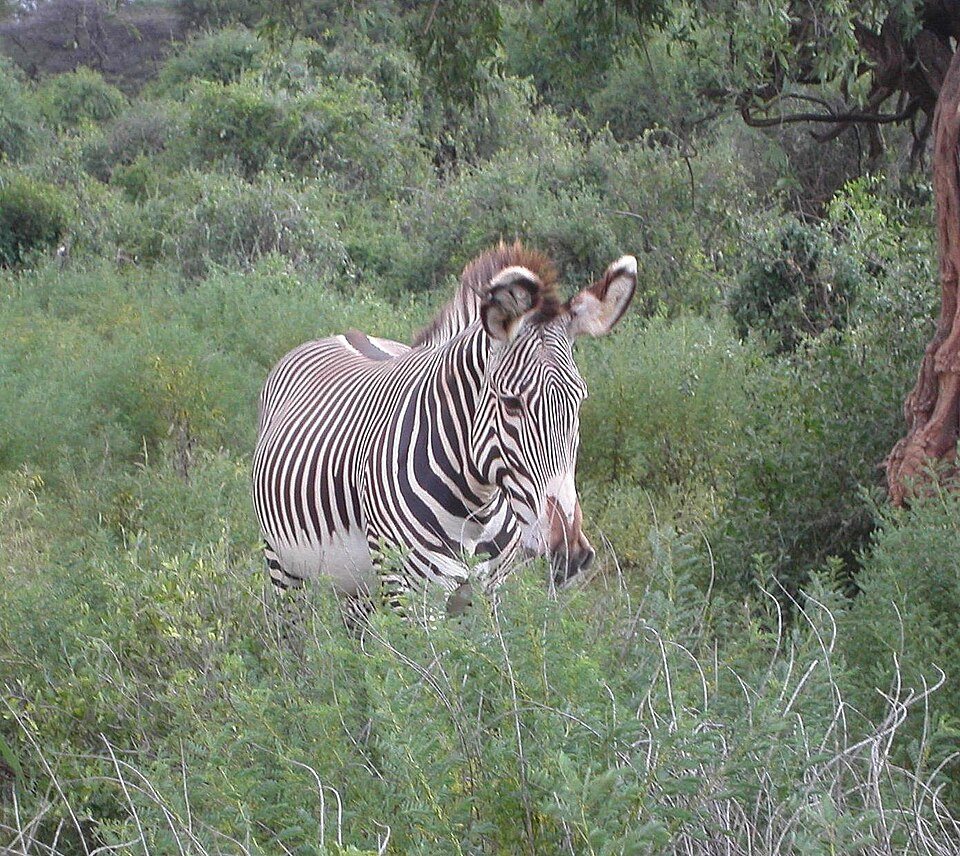
Photo: Jesse Hull · CC BY 2.0 (May be cropped or resized)
Equus grevyi
Conservation status: Unknown
Basic stats
Diet
Primarily grasses, with browse in dry periods
Habitat
Semi-arid grassland and shrubland
Litter size
1 foal
Gestation period
About 13 months
Weight
Adults roughly 350–450kg
Grevy's zebra is the largest wild zebra. Its stripes are very narrow and closely spaced, the belly is white and unstriped, and a broad black stripe runs along the spine. The head is long with enormous rounded ears, giving it a mule-like profile. These features separate it readily from the smaller plains zebra (Wikipedia, general species account; COMBINE, Soria et al. 2021).
Unlike plains zebras, Grevy's zebras do not form stable harems. Adult males hold territories around water and grazing, while females and young move in loose groups across dry country. They can survive several days without drinking but remain tied to water when nursing. In Kenya the key viewing areas are Samburu, Buffalo Springs, Shaba and Laikipia, especially Lewa. Kenya national status is unknown in this guide.
Where to see Grevy's Zebra in Kenya
GBIF records grouped by protected area. They show where the species has been reported, not that it is there now, and they are not population counts.
Recorded in 18 protected areas (1929–2025). The 8 with the most records:
- Meibae Community Conservancy: 42 records (2008)
- Lewa Wildlife Conservancy: 25 records (2008–2022)
- Buffalo Springs National Reserve: 22 records (1993–2025)
- Ol Jogi Conservancy: 22 records (2008)
- Kalama Community Conservancy: 17 records (1929–2008)
- Mpala Ranch: 16 records (2008–2020)
- Nakuprat-Gotu Community Wildlife Conservancy: 14 records (1929–2017)
- West Gate Community Conservancy: 11 records (2008)
Quick answers
- What does the Grevy's Zebra eat?
- Primarily grasses, with browse in dry periods
- What habitat does the Grevy's Zebra live in?
- Semi-arid grassland and shrubland
- What is the litter size of the Grevy's Zebra?
- 1 foal
- How long is the gestation period of the Grevy's Zebra?
- About 13 months
- How much does the Grevy's Zebra weigh?
- Adults roughly 350–450kg