
 Wildlife
of Kenya
Bush Hyrax
Hyraxes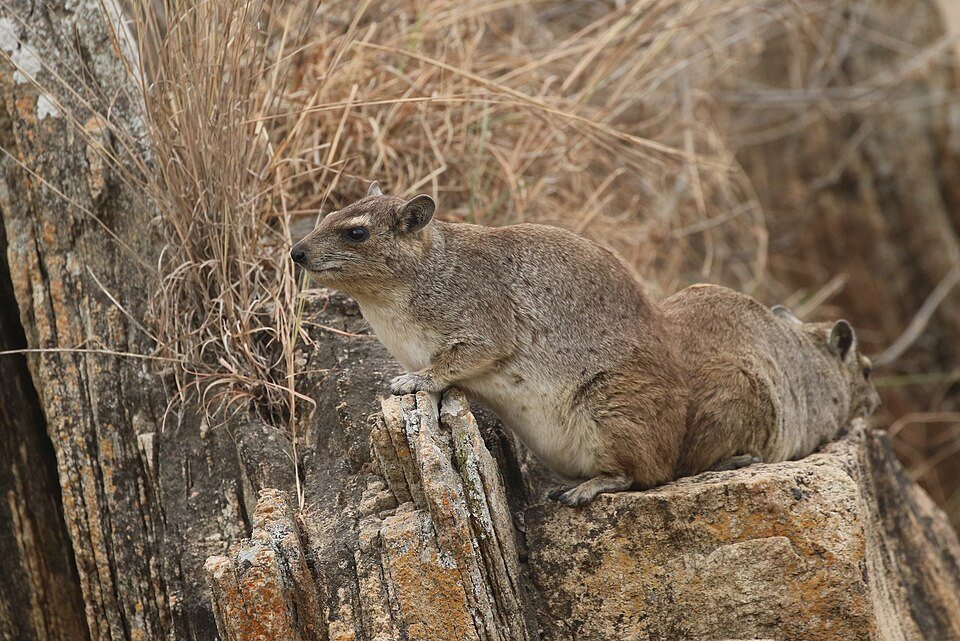
Photo: Henggang Cui · CC0
Heterohyrax brucei
Conservation status: Unknown
Basic stats
Diet
Plant matter, mainly leaves stripped from trees and branches
Habitat
Rocky kopjes, boulder piles and cliffs, up to 3800m in East Africa
Range
Eastern and southern Africa from Sudan and Eritrea to northern South Africa; isolated populations in Angola and DR Congo
Litter size
Averages about 2
Gestation period
About 228–229 days
Weight
About 2–2.5kg
The bush hyrax, also called the yellow-spotted rock hyrax, is smaller and less heavily built than the rock hyrax, with a narrower muzzle, though the two are hard to tell apart in the field. Like other hyraxes it has short-crowned cheek teeth, tusk-like upper incisors and comb-like lower incisors used for grooming. Weight averages about 2–2.5 kg (COMBINE, Soria et al. 2021; AnAge). Other names include Yellow-spotted Hyrax, Bruce's Yellow-spotted Dassie and Small-toothed Rock Hyrax (Wikipedia, general species account; GBIF vernacular names).
Diurnal, it feeds mostly in the morning and late afternoon, climbing vertical trunks and balancing on thin branches to strip leaves, and rarely feeds more than 20 m from its den. It is restricted to rocky kopjes and piles of large boulders with crevices at least 11 cm high and 1 m² of floor space, which give a steady 17–25 °C, and it is often found with rock hyraxes, sometimes in the same crevices. It is gregarious: groups are polygynous harems, each with one territorial male, up to 17 females and young, and they reach 34 animals. Males sing loudly in the mating season (GBIF description, Procaviidae).
Where to see Bush Hyrax in Kenya
GBIF records grouped by protected area. They show where the species has been reported, not that it is there now, and they are not population counts.
Recorded in 11 protected areas (1966–2026). The 8 with the most records:
- Mpala Ranch: 34 records (2014–2026)
- Masai Mara: 12 records (1996–2026)
- Mara Triangle: 9 records (1996–2026)
- Tsavo West National Park: 7 records (2007–2024)
- Ol Jogi Conservancy: 7 records (2015–2026)
- Meru National Park: 6 records (2018–2023)
- Tsavo East National Park: 5 records (2014–2026)
- Nairobi National Park: 4 records (2019–2026)
Quick answers
- What does the Bush Hyrax eat?
- Plant matter, mainly leaves stripped from trees and branches
- What habitat does the Bush Hyrax live in?
- Rocky kopjes, boulder piles and cliffs, up to 3800m in East Africa
- Where is the Bush Hyrax found?
- Eastern and southern Africa from Sudan and Eritrea to northern South Africa; isolated populations in Angola and DR Congo
- What is the litter size of the Bush Hyrax?
- Averages about 2
- How long is the gestation period of the Bush Hyrax?
- About 228–229 days
- How much does the Bush Hyrax weigh?
- About 2–2.5kg