
 Wildlife
of Kenya
Eastern Tree Hyrax
Hyraxes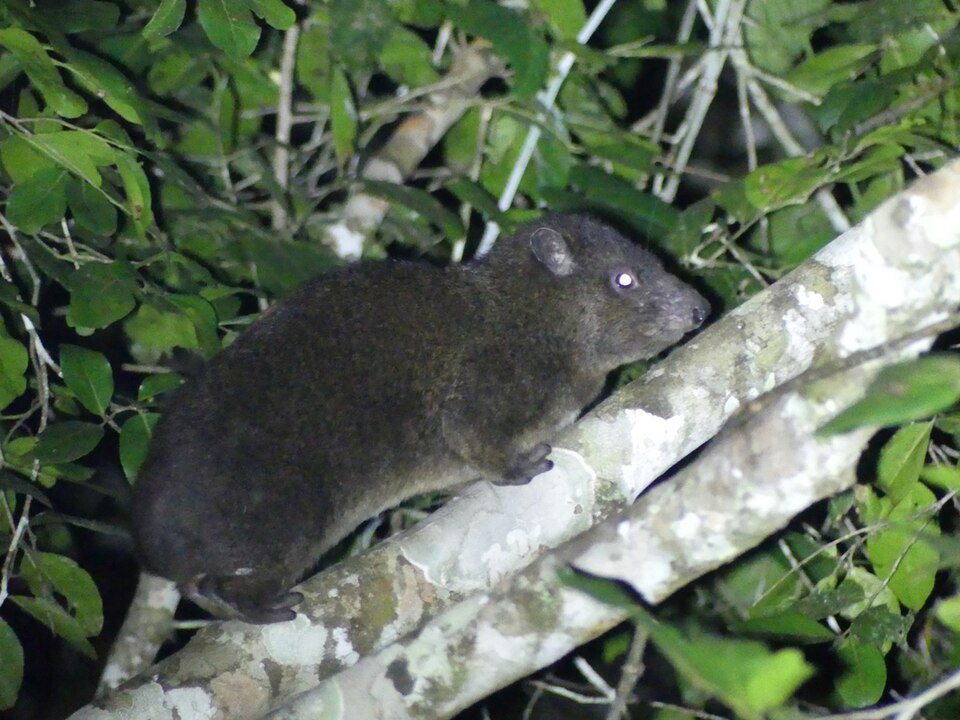
Photo: Valentin Moser · CC BY 4.0 (May be cropped or resized)
Dendrohyrax validus
Conservation status: Unknown
Basic stats
Diet
Leaves of trees and bushes
Habitat
Montane and adjacent lowland forest; dry coral forest on Zanzibar and Pemba; occasionally boulders and caves; to 3070m on Kilimanjaro
Range
Kenya and Tanzania, including Kilimanjaro, Mount Meru and the Eastern Arc Mountains
Size
Head and body 470–558mm
The eastern tree hyrax is a small, rotund, guinea-pig-like mammal with dense soft fur and blunt, nailed toes, and no visible tail. Head-and-body length is 470–558 mm. Colour varies from cinnamon brown to blackish with a paler underside, and a contrasting light patch of hairs marks the dorsal scent gland. The rostrum is long but well haired, unlike the western tree hyrax's. It is hard to tell from the southern tree hyrax, once considered the same species, which is usually more grizzled (Wikipedia, general species account). Another name is Eastern Tree Dassie.
It is solitary, living in tree holes, and communicates through repeated, varied calls and scent marking; it is one of few species said to sing, mostly in February and June. It climbs well, feeds mainly on leaves in the canopy, and builds large middens beside roost trees. Most roosts hold a single animal, except females with one young. In places on the Kenyan coast and in the Pare Mountains of Tanzania it also uses rocky boulders and caves. It is largely restricted to montane forests but also occurs in adjacent lowland forest, reaching 3,070 m on Kilimanjaro. Leopards, crowned eagles and pythons are predators (Wikipedia, general species account).
Quick answers
- What does the Eastern Tree Hyrax eat?
- Leaves of trees and bushes
- What habitat does the Eastern Tree Hyrax live in?
- Montane and adjacent lowland forest; dry coral forest on Zanzibar and Pemba; occasionally boulders and caves; to 3070m on Kilimanjaro
- Where is the Eastern Tree Hyrax found?
- Kenya and Tanzania, including Kilimanjaro, Mount Meru and the Eastern Arc Mountains
- How big is the Eastern Tree Hyrax?
- Head and body 470–558mm