
 Wildlife
of Kenya
Aardvark
Aardvark & Elephant Shrews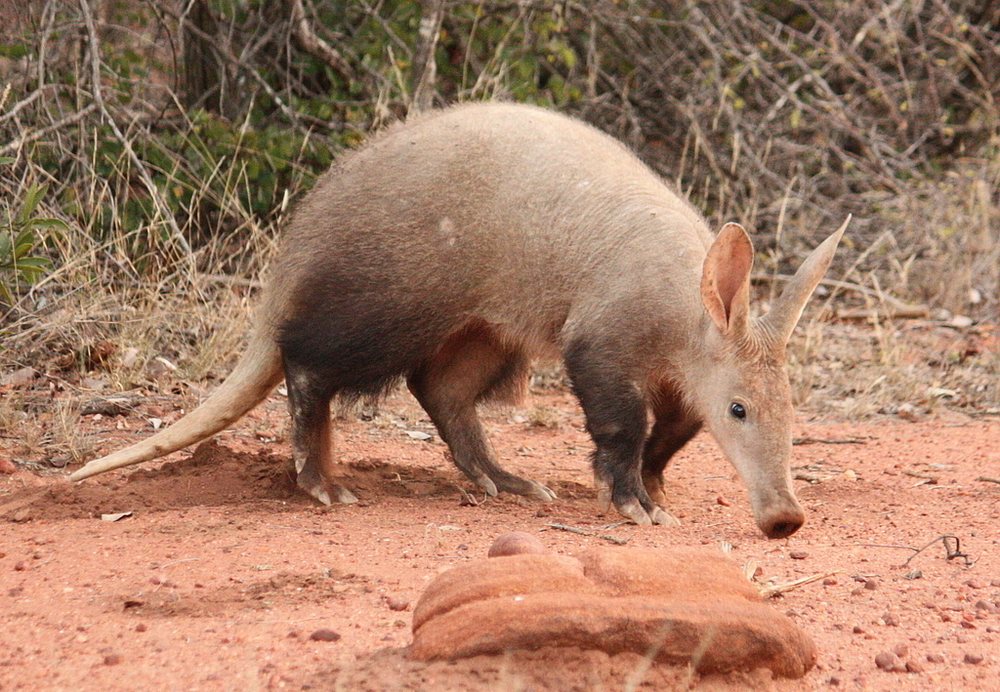
Photo: no rights reserved, uploaded by Kelly Abram · CC0
Orycteropus afer
Conservation status: Unknown
Basic stats
Diet
Ants and termites
Habitat
Grassland, savanna, semi-arid areas, thicket and forest, up to 3200m; not deserts or very hard, stony ground
Range
Southern two-thirds of Africa
Litter size
1 young
Gestation period
About 222–225 days
Size
Length 105–130cm; tail up to 70cm; about 60cm at the shoulder
Weight
60–80kg
The aardvark is a medium-sized, burrowing, nocturnal mammal, vaguely pig-like, with a stout body, a prominently arched back and sparse coarse hair. The limbs are of moderate length with longer hind legs; the front feet have four toes and the hind feet five, each with a large, robust, flattened nail midway between a claw and a hoof. The skin is tough and pale yellowish-grey, often stained reddish-brown by soil. Typical length is 105–130 cm plus a tail of up to 70 cm, height about 60 cm at the shoulder and weight 60–80 kg; there is no sexual dimorphism (Wikipedia, general species account). Other names include Antbear and Earth-hog.
Aardvarks are nocturnal, with occasional afternoon activity in winter where nights get cold, and sleep through the day in deep burrows. They feed on ants and termites, using sharp claws and powerful legs to dig them out and a long snout to find them, and are usually solitary. In the Nama Karoo of South Africa home ranges were 130–350 ha, and in Uganda an animal covered up to 14 km in one night. They occur in most habitat types, to 3,200 m in the Ethiopian highlands, but not in deserts or very hard, stony ground (GBIF description, Orycetropodidae).
Quick answers
- What does the Aardvark eat?
- Ants and termites
- What habitat does the Aardvark live in?
- Grassland, savanna, semi-arid areas, thicket and forest, up to 3200m; not deserts or very hard, stony ground
- Where is the Aardvark found?
- Southern two-thirds of Africa
- What is the litter size of the Aardvark?
- 1 young
- How long is the gestation period of the Aardvark?
- About 222–225 days
- How big is the Aardvark?
- Length 105–130cm; tail up to 70cm; about 60cm at the shoulder
- How much does the Aardvark weigh?
- 60–80kg