
 Wildlife
of Kenya
Four-toed Sengi
Aardvark & Elephant Shrews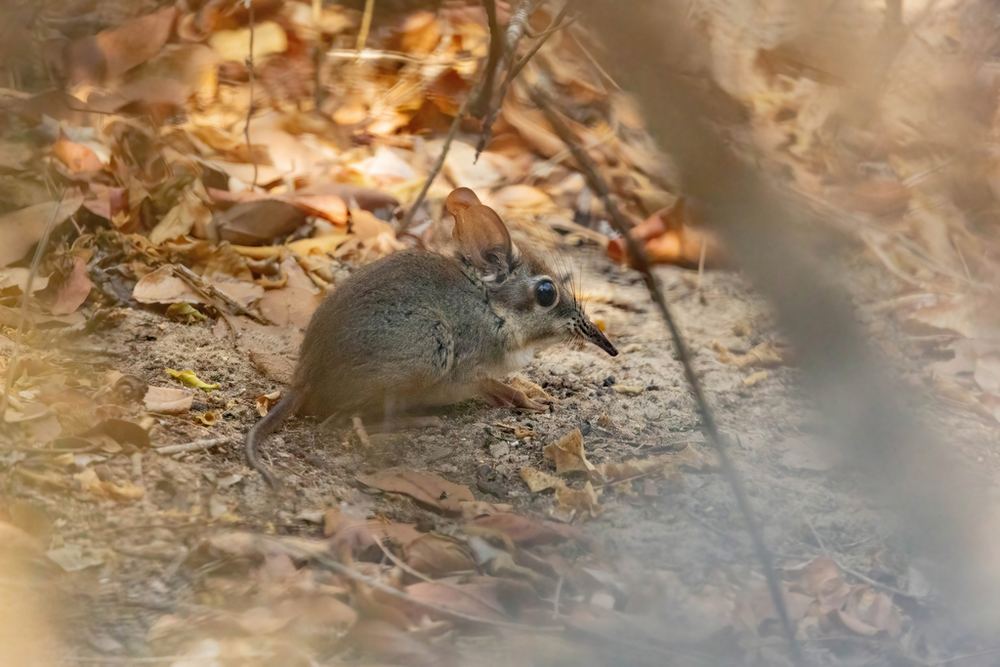
Photo: (c) Thibaud Aronson, some rights reserved (CC BY-SA) · CC BY-SA (May be cropped or resized)
Petrodromus tetradactylus
Conservation status: Unknown
Basic stats
Diet
Mainly invertebrates
Habitat
Dense forests, woodlands, thickets and moist savannas
Range
Central and Southern East Africa
Litter size
Usually one, sometimes two
Size
Body 19–23cm, tail 15.5–17cm
The four-toed sengi, also called the four-toed elephant shrew, stands as the sole living member of the genus Petrodromus within the order Macroscelidea. It has long, soft fur ranging from greyish pale brown to dark brown, white rings around the eyes and wide dark stripes on its back. Compared with other sengis, it has broad upstanding ears, large eyes and a long, pointed, flexible snout for hunting, plus four toes on its hind feet. Its body measures 19–23cm and its tail 15.5–17cm. Body weight is given as 120–250g by GBIF but 160–280g by Wikipedia, so no weight is listed (Wikipedia, general species account; GBIF description, Macroscelididae).
It is found in Central and Southern East Africa, including Angola, Kenya, Malawi, Mozambique, South Africa, Tanzania, Zambia and Zimbabwe, and possibly Namibia. It lives in dense forest, woodland, thickets and moist savanna, sheltering in dense undergrowth and, when pursued, retreating into hollow tree trunks or under logs. Males and females form monogamous pairs whose ranges overlap, though they spend most of their time alone. Mostly active in the daytime and early evening, it feeds on invertebrates, and litters usually contain one young, sometimes two (Wikipedia, general species account; GBIF description, Macroscelididae).
Quick answers
- What does the Four-toed Sengi eat?
- Mainly invertebrates
- What habitat does the Four-toed Sengi live in?
- Dense forests, woodlands, thickets and moist savannas
- Where is the Four-toed Sengi found?
- Central and Southern East Africa
- What is the litter size of the Four-toed Sengi?
- Usually one, sometimes two
- How big is the Four-toed Sengi?
- Body 19–23cm, tail 15.5–17cm