
 Wildlife
of Kenya
Blue Wildebeest
Antelopes & Other Bovids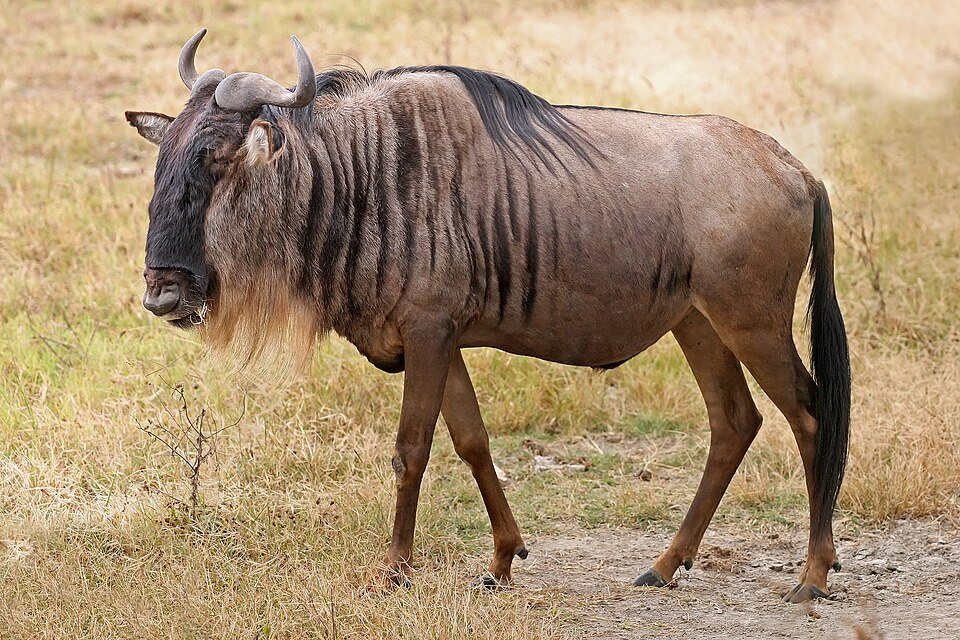
Photo: Muhammad Mahdi Karim · GFDL 1.2 (May be cropped or resized)
Connochaetes taurinus
Conservation status: Unknown
Basic stats
Diet
Mainly short grasses
Habitat
Savanna woodland, especially acacia, and short-grass plains
Range
Southern and eastern Africa
Litter size
1 calf
Gestation period
About 250 days
Size
Head and body 1.7–2.4m; height 1.15–1.45m
Weight
165–290kg (males), 140–260kg (females)
The blue wildebeest is a large, broad-shouldered antelope with a muscular, front-heavy build and a robust muzzle. Adults range from deep slate or bluish grey to light grey or greyish brown, and both sexes carry a pair of large curved horns. The tail is long and black, 60–100cm. Head and body measure 1.7–2.4m, height is 1.15–1.45m, and males weigh 165–290kg against 140–260kg for females. Young are born tawny brown and take on adult colouring from about two months (Wikipedia, general species account). Over half of its time is spent resting and 33% grazing (GBIF description, Bovidae).
The species is a grazer of short grasses and favours acacia savanna woodland with shade and water, moving to short-grass riverbanks in the dry season (GBIF description, Bovidae). Groups are territorial males, female herds and bachelor groups. Three populations make long migrations timed to rainfall, and in Kruger the rut runs from April to early June. Gestation is about 250 days, calves stand within five minutes, and they suckle for about eight months (GBIF description, Bovidae). It is native to Angola, Botswana, Eswatini, Kenya, Mozambique, South Africa, Tanzania, Zambia and Zimbabwe, is extinct in Malawi and has been reintroduced in Namibia (Wikipedia, general species account).
Where to see Blue Wildebeest in Kenya
GBIF records grouped by protected area. They show where the species has been reported, not that it is there now, and they are not population counts.
Recorded in 16 protected areas (1968–2026). The 8 with the most records:
- Masai Mara: 145 records (1985–2026)
- Amboseli National Park: 66 records (1989–2026)
- Mara Triangle: 34 records (2003–2025)
- Chyulu Hills: 28 records (2015)
- Mara North Conservancy: 13 records (2010–2025)
- Nairobi National Park: 12 records (1968–2023)
- Crescent Island Widlife Sanctuary: 11 records (2015–2024)
- Naboisho Conservancy: 8 records (2017–2026)
Quick answers
- What does the Blue Wildebeest eat?
- Mainly short grasses
- What habitat does the Blue Wildebeest live in?
- Savanna woodland, especially acacia, and short-grass plains
- Where is the Blue Wildebeest found?
- Southern and eastern Africa
- What is the litter size of the Blue Wildebeest?
- 1 calf
- How long is the gestation period of the Blue Wildebeest?
- About 250 days
- How big is the Blue Wildebeest?
- Head and body 1.7–2.4m; height 1.15–1.45m
- How much does the Blue Wildebeest weigh?
- 165–290kg (males), 140–260kg (females)