
 Wildlife
of Kenya
Waterbuck
Antelopes & Other Bovids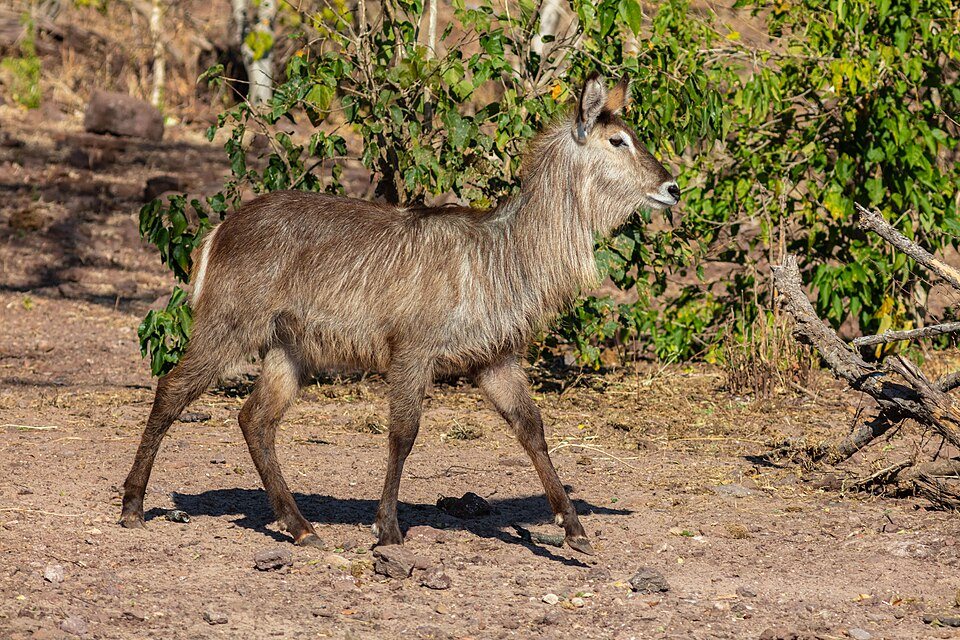
Photo: Diego Delso · CC BY-SA 4.0 (May be cropped or resized)
Kobus ellipsiprymnus
Conservation status: Unknown
Basic stats
Diet
Mostly grass
Habitat
Scrub, savanna and grassland near water
Range
Sub-Saharan Africa
Litter size
1 calf
Gestation period
7–8 months
Size
Head and body 177–235cm; height 120–136cm
Weight
198–262kg (males), 161–214kg (females)
The waterbuck is a large antelope of sub-Saharan Africa and the largest of the six Kobus species. Head and body measure 177–235cm and height is 120–136cm, males weigh 198–262kg and females 161–214kg, and the tail is 22–45cm. The shaggy coat is reddish brown to grey and darkens with age, males being darker. The hair on the neck is long, and it has a white muzzle, a cream-coloured bib on the throat and short, strong black legs. Only males have long spiral horns, 55–99cm. The skin secretes a greasy, musky substance (Wikipedia, general species account).
Waterbucks are rather sedentary and need to be close to water. They live in scrub and savanna along rivers, lakes and valleys and are mostly grazers. Females and young animals form small groups of up to 20 whose membership is flexible, while males are solitary or in bachelor groups of four to six. Territorial males are most dominant from six to nine years. Births peak in the rainy season, gestation is seven to eight months, and a single calf is born (GBIF description, Bovidae; Wikipedia, general species account).
Where to see Waterbuck in Kenya
GBIF records grouped by protected area. They show where the species has been reported, not that it is there now, and they are not population counts.
Recorded in 19 protected areas (1987–2026). The 8 with the most records:
- Tsavo East National Park: 23 records (1989–2026)
- Buffalo Springs National Reserve: 18 records (2003–2026)
- Amboseli National Park: 13 records (1989–2026)
- Masai Mara: 12 records (1989–2022)
- Meru National Park: 9 records (2013–2025)
- Tsavo West National Park: 9 records (1989–2024)
- Samburu National Reserve: 9 records (1994–2021)
- Lake Nakuru National Park: 8 records (1989–2025)
Quick answers
- What does the Waterbuck eat?
- Mostly grass
- What habitat does the Waterbuck live in?
- Scrub, savanna and grassland near water
- Where is the Waterbuck found?
- Sub-Saharan Africa
- What is the litter size of the Waterbuck?
- 1 calf
- How long is the gestation period of the Waterbuck?
- 7–8 months
- How big is the Waterbuck?
- Head and body 177–235cm; height 120–136cm
- How much does the Waterbuck weigh?
- 198–262kg (males), 161–214kg (females)