
 Wildlife
of Kenya
Yellow-backed Duiker
Antelopes & Other Bovids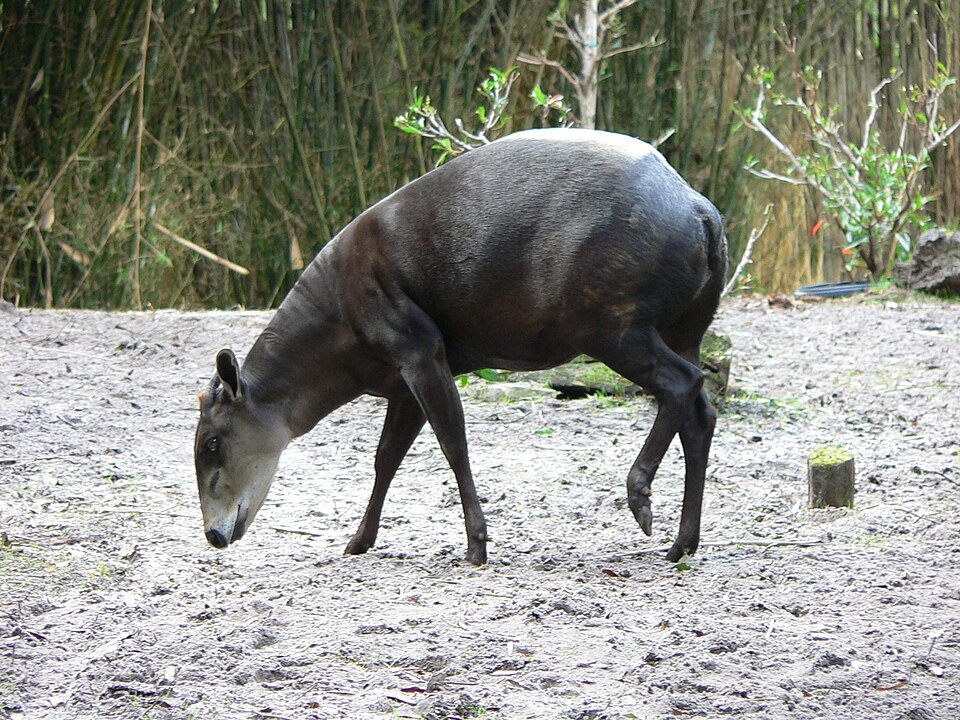
Photo: Raul654 · CC BY-SA 3.0 (May be cropped or resized)
Cephalophus silvicultor
Conservation status: Unknown
Basic stats
Diet
Mainly fruit; also shoots, roots, leaves and buds
Habitat
Rainforest, semi-deciduous, riparian and montane forest; also open bush
Range
Central and West Africa, from Senegal to Uganda and south to Zambia
Litter size
1 calf
Gestation period
At least about 7 months
Size
Head and body 115–145cm; tail 11–18cm
Weight
About 60–80kg
The yellow-backed duiker is the largest of its genus and the most widely distributed duiker. Head and body measure 115–145cm, the tail 11–18cm, and weight is about 60–80kg. The body is convex, standing taller at the rump than at the shoulder, and the horns are very short, 8.5–21cm, cylindrical and ribbed at the base, with an orange crest between them. It is named for a patch of yellow hairs on the rump that stand erect when the animal is alarmed. Females are often slightly larger than males (Wikipedia, general species account).
It is mainly a forest dweller, living in rainforest, semi-deciduous, riparian and montane forest, but it can be found in open bush and savanna clearings. It is active throughout the day and night and lives mainly alone or in pairs. It feeds selectively on shoots, roots, leaves and buds, but mostly fruit. Breeding is not seasonal, one calf is born, and it hides alone for its first period. Gestation is reported over a wide range, but is likely at least seven months. A captive animal lived 22.5 years (GBIF description, Bovidae; Wikipedia, general species account).
Quick answers
- What does the Yellow-backed Duiker eat?
- Mainly fruit; also shoots, roots, leaves and buds
- What habitat does the Yellow-backed Duiker live in?
- Rainforest, semi-deciduous, riparian and montane forest; also open bush
- Where is the Yellow-backed Duiker found?
- Central and West Africa, from Senegal to Uganda and south to Zambia
- What is the litter size of the Yellow-backed Duiker?
- 1 calf
- How long is the gestation period of the Yellow-backed Duiker?
- At least about 7 months
- How big is the Yellow-backed Duiker?
- Head and body 115–145cm; tail 11–18cm
- How much does the Yellow-backed Duiker weigh?
- About 60–80kg