
 Wildlife
of Kenya
Thick-tailed Greater Galago
Primates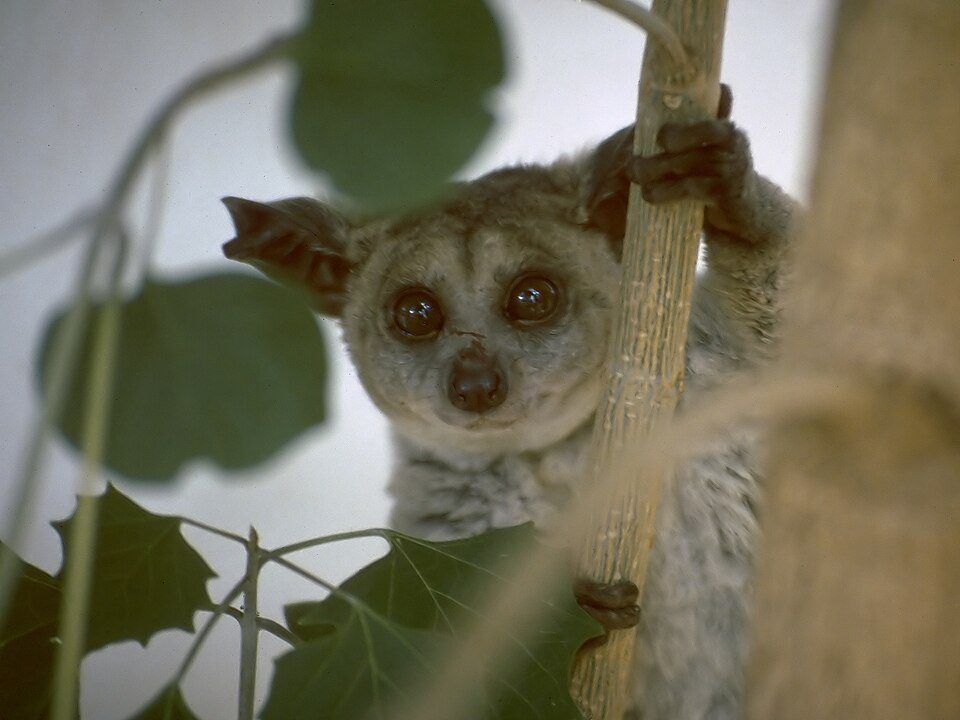
Photo: Hans Hillewaert · CC BY-SA 3.0 (May be cropped or resized)
Otolemur crassicaudatus
Conservation status: Unknown
Basic stats
Diet
Fruit, seeds, gum, flowers, insects, slugs, reptiles and small birds
Habitat
Gallery, coastal and montane forest, woodland savanna and bamboo thickets, up to 1,800m
Range
Southern and East Africa
Litter size
Normally 2
Gestation period
126–135 days
Size
Head and body 26–47cm; tail 29–55cm
Weight
0.5–2kg (about 1.2kg females, 1.5kg males)
The thick-tailed greater galago, or brown greater galago, is the largest galago. It has a rounded head with a short, wide snout and very large ears that move independently. Head and body average 32cm within a range of 26–47cm, the tail is 29–55cm, and weight is 0.5–2kg, with males averaging about 1.5kg and females 1.2kg. The thick fur varies from buff to gray or brown above and cream to yellow below. It climbs and walks rather than leaping (Wikipedia, general species account).
It lives in gallery, coastal and montane forest, woodland savanna and bamboo thickets in southern and East Africa, and has adapted to farmland, orchards and plantations, occurring up to 1,800m. It is the most gregarious galago, in small stable family groups of 2–6. It eats fruit, seeds, acacia gum, flowers, insects and sometimes reptiles and small birds. Births are recorded from August to November, normally of two young after 126–135 days. Weaning takes 70–134 days (GBIF description, Galagidae; Wikipedia, general species account).
Quick answers
- What does the Thick-tailed Greater Galago eat?
- Fruit, seeds, gum, flowers, insects, slugs, reptiles and small birds
- What habitat does the Thick-tailed Greater Galago live in?
- Gallery, coastal and montane forest, woodland savanna and bamboo thickets, up to 1,800m
- Where is the Thick-tailed Greater Galago found?
- Southern and East Africa
- What is the litter size of the Thick-tailed Greater Galago?
- Normally 2
- How long is the gestation period of the Thick-tailed Greater Galago?
- 126–135 days
- How big is the Thick-tailed Greater Galago?
- Head and body 26–47cm; tail 29–55cm
- How much does the Thick-tailed Greater Galago weigh?
- 0.5–2kg (about 1.2kg females, 1.5kg males)