
 Wildlife
of Kenya
Angolan Colobus
Primates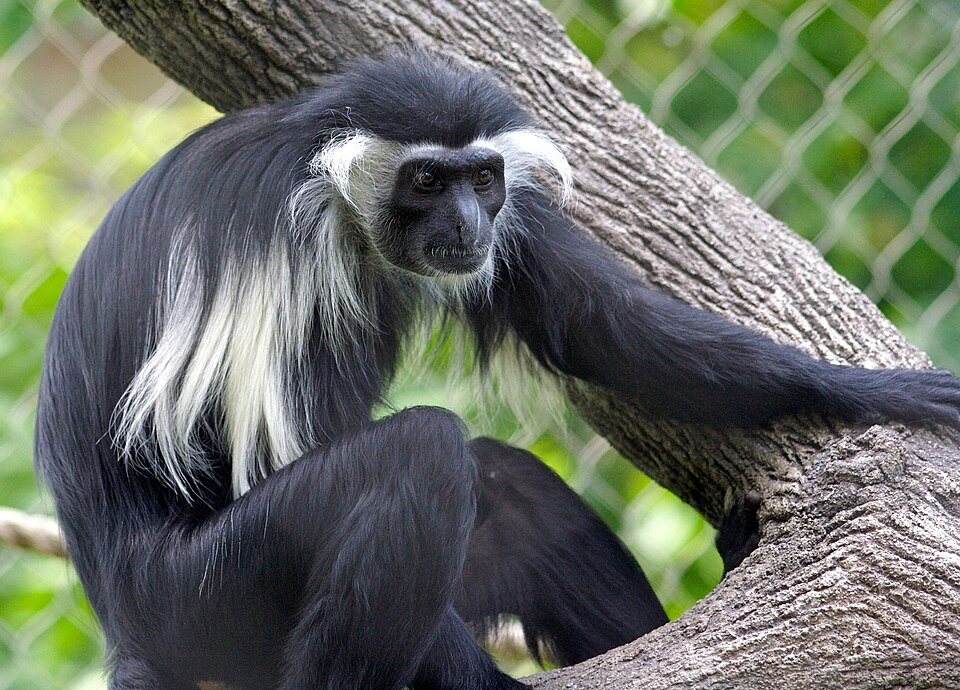
Photo: Ryan E. Poplin · CC BY-SA 2.0 (May be cropped or resized)
Colobus angolensis
Conservation status: Unknown
Basic stats
Diet
Mostly leaves, with lesser amounts of fruit and seeds
Habitat
Primary and secondary lowland rainforest, gallery and montane forest, to 3000m (4000m on Ruwenzori); prefers the top of the canopy
Range
Congo Basin and East Africa, including Kenya, Tanzania, Uganda, Rwanda and Burundi
Litter size
1 young
Size
Head and body 55–66cm (males), 48–59cm (females); tail 76–92cm and 63–76cm
Weight
7.6–12.6kg (males), 6.4–9.2kg (females)
The Angolan colobus is generally black, with long white epaulettes on the shoulders and fluffy white hair around the face that forms laterally elongated tufts on the cheeks. The long, thin tail is black or white but always has a white tip, and is tufted in males. The amount of white varies regionally, and mountain animals have longer, thicker fur than lowland ones. Males measure 55–66 cm and weigh 7.6–12.6 kg, females 48–59 cm and 6.4–9.2 kg (GBIF description, Cercopithecidae; Wikipedia, general species account). Other names include Angola Colobus and Angolan Black-and-white Colobus.
It is diurnal and arboreal, preferring the highest canopy and emergent trees but occasionally descending near streams to feed on herbs. It lives in primary and secondary lowland rainforest, gallery forest and montane forest to 3,000 m, and as high as 4,000 m on Mount Ruwenzori. Small family groups of 3–4 with one male form troops of up to 25–30; one population in Nyungwe Forest, Rwanda, has a troop of over 300 on a 2,440 ha range. Daily movement is about 983 m on a 371 ha range. Births occur May–December, and the single white-coated young turns grey and then black over six months. The diet is mostly leaves (GBIF description, Cercopithecidae; Wikipedia, general species account).
Where to see Angolan Colobus in Kenya
GBIF records grouped by protected area. They show where the species has been reported, not that it is there now, and they are not population counts.
Recorded in 22 protected areas (1996–2026). The 8 with the most records:
- Shurr Community Conservancy: 84 records (2008)
- Melako Community Conservancy: 61 records (2008)
- Meibae Community Conservancy: 47 records (2008)
- Kinna Community Conservancy: 36 records (2008)
- West Gate Community Conservancy: 29 records (2008)
- Garbatulla Community Conservancy: 23 records (2008)
- Kirisa-Nkoteiya Conservancy: 17 records (2008)
- Ndoto Conservancy: 15 records (2008)
Quick answers
- What does the Angolan Colobus eat?
- Mostly leaves, with lesser amounts of fruit and seeds
- What habitat does the Angolan Colobus live in?
- Primary and secondary lowland rainforest, gallery and montane forest, to 3000m (4000m on Ruwenzori); prefers the top of the canopy
- Where is the Angolan Colobus found?
- Congo Basin and East Africa, including Kenya, Tanzania, Uganda, Rwanda and Burundi
- What is the litter size of the Angolan Colobus?
- 1 young
- How big is the Angolan Colobus?
- Head and body 55–66cm (males), 48–59cm (females); tail 76–92cm and 63–76cm
- How much does the Angolan Colobus weigh?
- 7.6–12.6kg (males), 6.4–9.2kg (females)