
 Wildlife
of Kenya
Vervet Monkey
Primates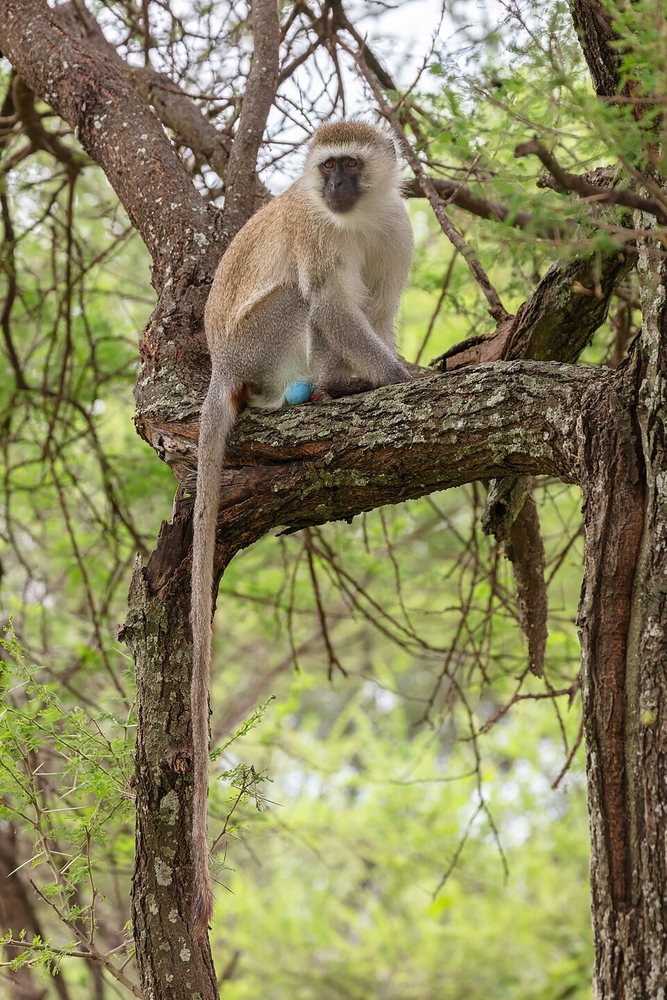
Photo: Diego Delso · CC BY-SA 4.0 (May be cropped or resized)
Chlorocebus pygerythrus
Conservation status: Unknown
Basic stats
Diet
Mostly plant food; fruit, flowers, leaves and grasses
Habitat
Savanna, riverine woodland, coastal forest, forest edge and farmland, up to 4000m
Range
Southern and East Africa from Ethiopia and South Sudan to South Africa; introduced to Cape Verde, Saint Helena and Caribbean islands
Size
Head and body 420–600mm (males, average 490mm), 300–495mm (females, average 426mm)
Weight
Males 3.9–8kg (average 5.5kg); females 3.4–5.3kg (average 4.1kg)
The vervet monkey resembles a grey langur, with a black face fringed in white and mostly grizzled-grey body hair. Males are larger and have a turquoise-blue scrotum. Adult males weigh 3.9–8.0 kg, averaging 5.5 kg, with a head-and-body length of 420–600 mm; adult females weigh 3.4–5.3 kg, averaging 4.1 kg, and measure 300–495 mm. Five subspecies are recognised, and the term vervet is also used for all members of the genus Chlorocebus (Wikipedia, general species account).
Vervets are diurnal and mainly terrestrial, spending 30–40 percent of their time feeding and a similar amount scanning for predators and others of their kind. Groups contain several males and females, up to 75 animals; males transfer between groups while females stay in their natal group and keep strict matrilineal relationships. They are aggressively territorial and have well-studied predator-specific alarm calls. They occupy savanna, open woodland, forest edge and cultivated areas, are often associated with miombo woodland, and are generally absent from desert and deep forest (GBIF description, Cercopithecidae). Introduced populations exist in Cape Verde, Saint Helena and Barbados (Wikipedia, general species account).
Where to see Vervet Monkey in Kenya
GBIF records grouped by protected area. They show where the species has been reported, not that it is there now, and they are not population counts.
Recorded in 20 protected areas (1985–2026). The 8 with the most records:
- Masai Mara: 30 records (1985–2026)
- Amboseli National Park: 28 records (1989–2026)
- Buffalo Springs National Reserve: 16 records (2003–2025)
- Nairobi National Park: 15 records (1987–2026)
- Tsavo East National Park: 15 records (1989–2026)
- Lake Nakuru National Park: 13 records (1989–2025)
- Mpala Ranch: 13 records (2015–2026)
- Hell's Gate National Park: 11 records (2017–2026)
Quick answers
- What does the Vervet Monkey eat?
- Mostly plant food; fruit, flowers, leaves and grasses
- What habitat does the Vervet Monkey live in?
- Savanna, riverine woodland, coastal forest, forest edge and farmland, up to 4000m
- Where is the Vervet Monkey found?
- Southern and East Africa from Ethiopia and South Sudan to South Africa; introduced to Cape Verde, Saint Helena and Caribbean islands
- How big is the Vervet Monkey?
- Head and body 420–600mm (males, average 490mm), 300–495mm (females, average 426mm)
- How much does the Vervet Monkey weigh?
- Males 3.9–8kg (average 5.5kg); females 3.4–5.3kg (average 4.1kg)