
 Wildlife
of Kenya
Suni
Antelopes & Other Bovids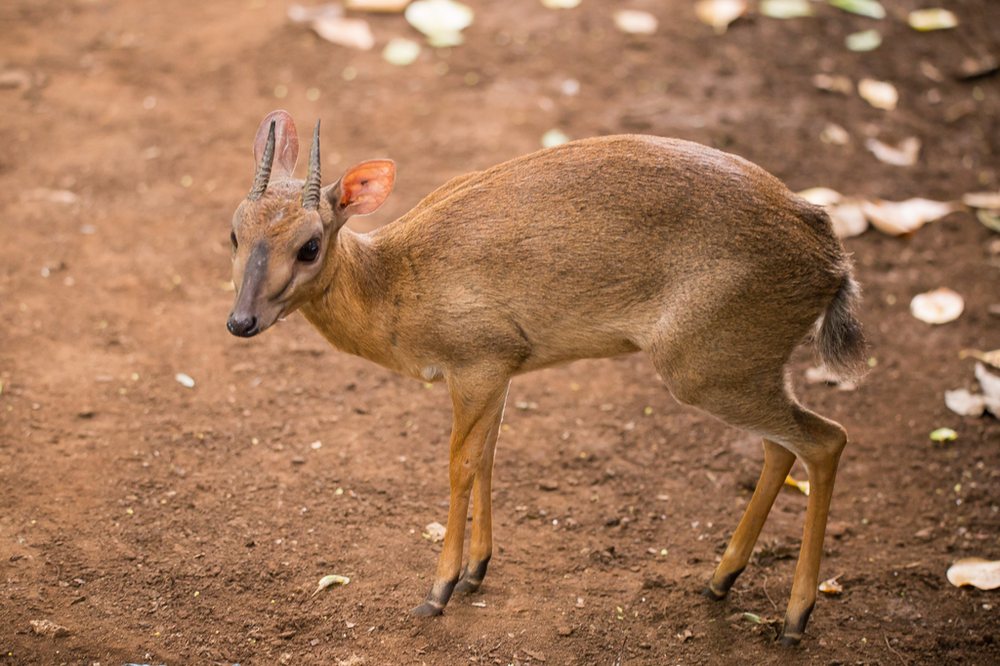
Photo: (c) Diogo Luiz, some rights reserved (CC BY), uploaded by Diogo Luiz · CC-BY (May be cropped or resized)
Nesotragus moschatus
Conservation status: Unknown
Basic stats
Diet
Leaves, fungi, fruits and flowers
Habitat
Dense underbrush
Range
Central Kenya to KwaZulu-Natal; Zanzibar
Litter size
1 calf
Gestation period
About 180–183 days
Size
Shoulder height 30–43cm; head and body 57–62cm
Weight
4.5–7kg
The suni is a small antelope and one of the smallest ungulates, found in dense underbrush from central Kenya to KwaZulu-Natal in South Africa, and on Zanzibar. It stands 30–43cm at the shoulder and weighs 4.5–7kg. It is usually reddish brown, darker on the back than on the sides and legs, with a white belly, chin, throat and inner legs. The nostrils are prominent and red, and there are black rings around the eyes and above the hooves. Only males have horns, 8–13cm long, ridged along most of their length and curving backward (Wikipedia, general species account).
Suni eat leaves, fungi, fruits and flowers and need almost no free water. They are shy, mostly nocturnal, and sleep by day in a shady, sheltered place. Males defend a territory of about three hectares, marking the boundaries with preorbital gland secretions, and a male usually takes one mate. A single calf is born after a gestation of about 183 days, and AnAge lists 180 days. Predators include cats, raptors and snakes, and a suni stays still until it springs away (Wikipedia, general species account).
Where to see Suni in Kenya
GBIF records grouped by protected area. They show where the species has been reported, not that it is there now, and they are not population counts.
Recorded in 6 protected areas (1906–2025).
- Nairobi National Park: 10 records (2015–2023)
- Mount Kenya National Park: 7 records (1906–2003)
- Arabuko-Sokoke Forest Reserve: 5 records (1965–2023)
- Aberdare National Park: 4 records (2021–2025)
- Chyulu Hills: 4 records (2015)
- Mount Kenya National Reserve: 3 records (2003)
Quick answers
- What does the Suni eat?
- Leaves, fungi, fruits and flowers
- What habitat does the Suni live in?
- Dense underbrush
- Where is the Suni found?
- Central Kenya to KwaZulu-Natal; Zanzibar
- What is the litter size of the Suni?
- 1 calf
- How long is the gestation period of the Suni?
- About 180–183 days
- How big is the Suni?
- Shoulder height 30–43cm; head and body 57–62cm
- How much does the Suni weigh?
- 4.5–7kg