
 Wildlife
of Kenya
Egyptian Rousette
Bats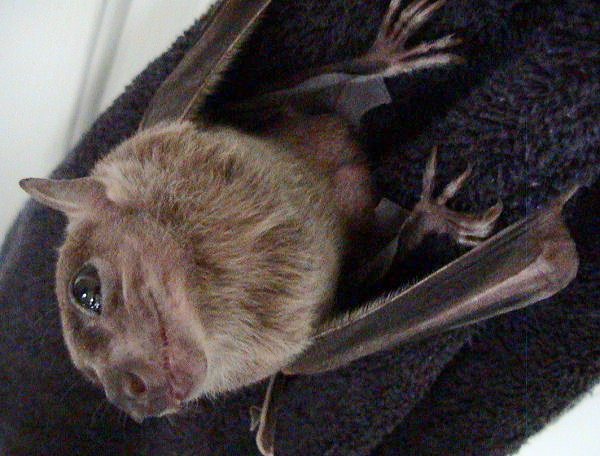
Photo: The original uploader was Dawson at English Wikipedia. · CC BY-SA 2.5 (May be cropped or resized)
Rousettus aegyptiacus
Conservation status: Unknown
Basic stats
Diet
Fruit that changes with season and availability
Habitat
Arid to moist tropical biomes, sea level to about 4000m
Range
Africa, Middle East, Mediterranean and Indian subcontinent
Litter size
One young
Gestation period
116 days
Size
Forearm 81–102mm
Weight
Adults 80–170g
The Egyptian Rousette, also called the Egyptian fruit bat, is a medium-sized megabat in the family Pteropodidae, with adults weighing 80–170g and a wingspan of about 60cm. Its forearm is 81–102mm and its thumb 22–31mm. Males are larger than females and can be told apart by their large scrotums and stiff strands of hair around the throat. Its fur is short, soft and sleek, dark brown to grey-brown on the back and pale brown below with a yellowish-brown collar, and its wings are darker than the body. It has 34 teeth. It is one of three Rousettus species with an African-Malagasy range, and the only one found in continental Africa (Wikipedia, general species account).
It is highly social, usually living in colonies of 100 to several thousand bats, sometimes up to 40,000–50,000, with the sexes separating during the summer breeding season when females form nursery colonies (GBIF description, Pteropodidae). Its diet changes with the season and local fruit supply, and farmers sometimes treat it as a pest because it eats commercial fruit, though it also pollinates plants and disperses seeds. It is found from sea level up to about 4000m in arid to moist tropical biomes. Gestation lasts 116 days, litters contain one young, and the species can live to 22.9 years (Wikipedia, general species account; GBIF description, Pteropodidae; AnAge).
Where to see Egyptian Rousette in Kenya
GBIF records grouped by protected area. They show where the species has been reported, not that it is there now, and they are not population counts.
Recorded in 7 protected areas (1965–2021).
- Mount Elgon National Park: 94 records (1972–2021)
- Arabuko-Sokoke Forest Reserve: 54 records (1965–2012)
- Soysambu Conservancy: 19 records (2016)
- Proposed Elang'ata Enterit Conservancy: 8 records (1974)
- Kagamega Forest: 7 records (2014–2016)
- Shimba Hills National Reserve: 7 records (1966)
- Watamu Marine National Park: 6 records (2006)
Quick answers
- What does the Egyptian Rousette eat?
- Fruit that changes with season and availability
- What habitat does the Egyptian Rousette live in?
- Arid to moist tropical biomes, sea level to about 4000m
- Where is the Egyptian Rousette found?
- Africa, Middle East, Mediterranean and Indian subcontinent
- What is the litter size of the Egyptian Rousette?
- One young
- How long is the gestation period of the Egyptian Rousette?
- 116 days
- How big is the Egyptian Rousette?
- Forearm 81–102mm
- How much does the Egyptian Rousette weigh?
- Adults 80–170g