
 Wildlife
of Kenya
Egyptian Slit-faced Bat
Bats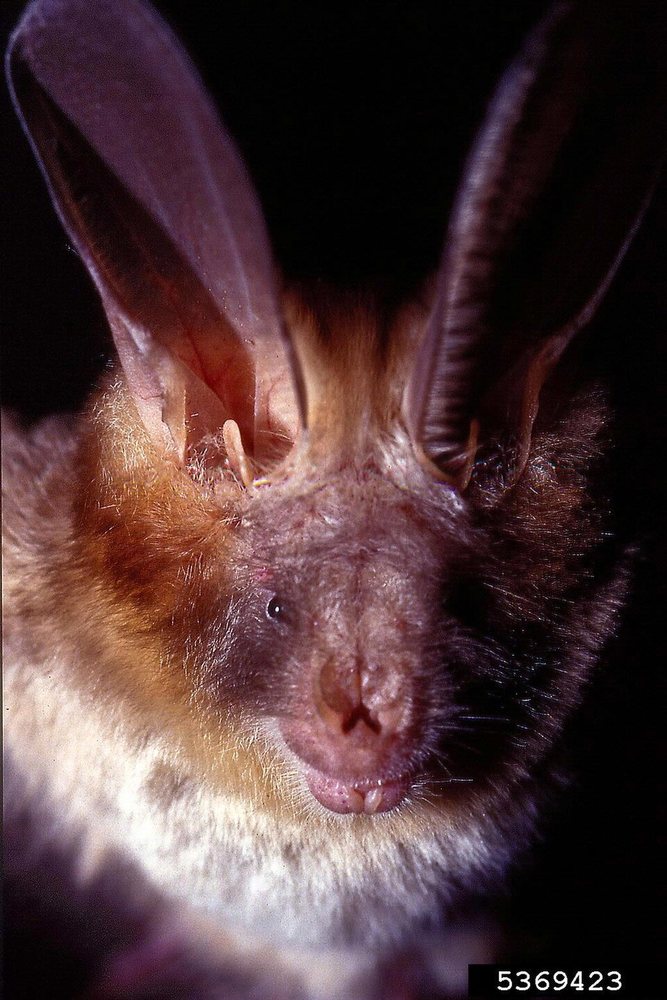
Photo: Susan Ellis, Bugwood.org · CC BY 3.0 us (May be cropped or resized)
Nycteris thebaica
Conservation status: Unknown
Basic stats
Diet
Insects, a wide range of prey taken according to availability
Habitat
Savanna and semiarid environments, riverine and coastal forest; avoids tropical rainforest
Range
Throughout Africa and the Arabian Peninsula
Litter size
One
The Egyptian slit-faced bat takes its name from a deep slit that runs from the base of the ears to the nostrils, between the noseleaves. Its back is dusky to reddish brown, while its underside is white to whitish grey, and its fur is paler than that of other nycterids. Its wings are broad with a low aspect ratio and a wingspan of 283mm, which lets it hover close to the ground. Females are on average larger than males, though the sexes overlap widely in size. Six subspecies are known (Wikipedia, general species account; GBIF description, Nycteridae).
It is broadly distributed through Africa and the Arabian Peninsula. It favours savanna and semiarid settings, plus riverine and coastal forest, while avoiding tropical rainforest and montane habitats, from sea level to over 1500m. Colonies can reach several hundred bats, or a thousand in caves. It is a generalist, opportunistic feeder that takes a wide range of prey depending on availability and season, locating it with high-frequency echolocation. In southern Africa births are seasonal, with a single young born in the early wet season, around November, after a gestation of about five months. The mother carries the young, which clings to her nipple, and suckling lasts about two months (Wikipedia, general species account; GBIF description, Nycteridae).
Where to see Egyptian Slit-faced Bat in Kenya
GBIF records grouped by protected area. They show where the species has been reported, not that it is there now, and they are not population counts.
Recorded in 12 protected areas (1949–2016). The 8 with the most records:
- Kagamega Forest: 54 records (2012–2014)
- Shimba Hills National Reserve: 50 records (1965–2012)
- Masai Mara: 44 records (1983)
- Arabuko-Sokoke Forest Reserve: 22 records (2006–2012)
- Lake Nakuru National Park: 19 records (2012–2016)
- Mount Elgon National Park: 12 records (1972)
- Loldaiga Hills Conservancy: 10 records (2014)
- Mara Triangle: 5 records (1983)
Quick answers
- What does the Egyptian Slit-faced Bat eat?
- Insects, a wide range of prey taken according to availability
- What habitat does the Egyptian Slit-faced Bat live in?
- Savanna and semiarid environments, riverine and coastal forest; avoids tropical rainforest
- Where is the Egyptian Slit-faced Bat found?
- Throughout Africa and the Arabian Peninsula
- What is the litter size of the Egyptian Slit-faced Bat?
- One