
 Wildlife
of Kenya
Hammer-headed Fruit Bat
Bats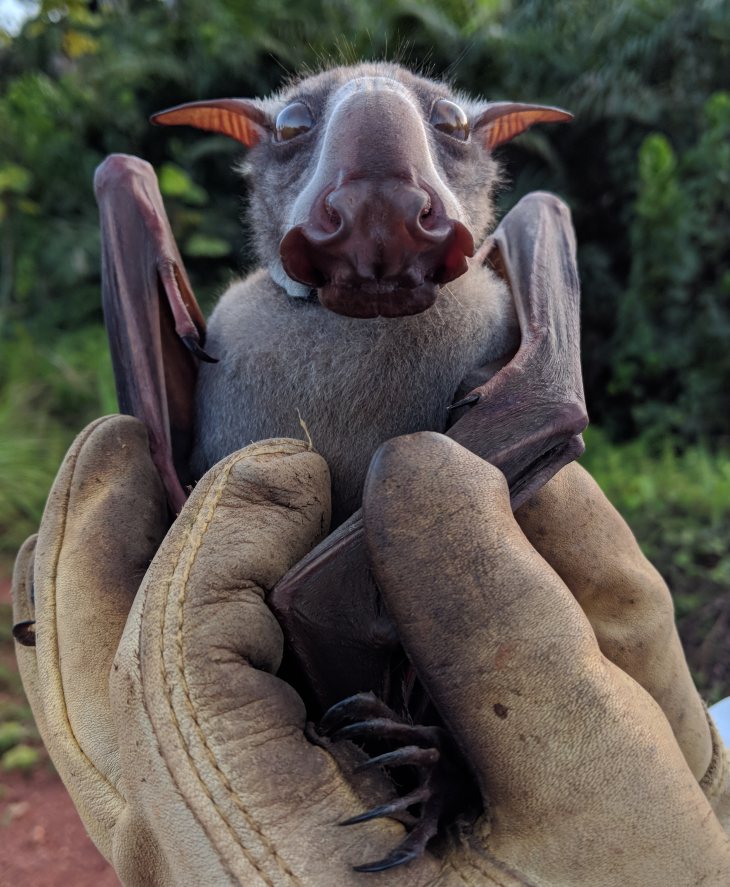
Photo: Sarah H. Olson, Gerard Bounga, Alain Ondzie, Trent Bushmaker, Stephanie N. Seifert, Eeva Kuisma, Dylan W. Taylor, Vincent J. Munster, Chris Walzer · CC0
Hypsignathus monstrosus
Conservation status: Unknown
Basic stats
Diet
Mostly fruit such as figs, bananas and mangoes
Habitat
Lowland forest, swamp forest and woodland mosaics, up to about 1800m
Range
West and Central Africa
Size
Males wingspan up to 90.1cm
Weight
Males about 420g, females about 234g
The hammer-headed bat, also called the hammer-headed fruit bat, big-lipped bat or hammerhead bat, is the only member of the genus Hypsignathus and the largest bat in continental Africa. Males have wingspans up to 90.1cm, and every individual has a forearm longer than 112mm. Males average 420g and females 234g, so this bat's sexual dimorphism is more pronounced than that of any other bat. Males have larynges roughly three times the size of females' and large resonating chambers on their faces, which help them produce loud calls, while females look more like a typical megabat with a fox-like face (Wikipedia, general species account).
It occurs widely across West and Central Africa, living in lowland forest, swamp forest, forest-grassland mosaics and riverine corridors up to about 1800m (GBIF description, Pteropodidae). Its diet is mostly fruit such as figs, bananas and mangoes, with meat eating noted only a few times. It forages at night and rests by day in tree roosts. Males gather in leks, typically in long, thin stretches of land such as along rivers, and honk to attract females. The most successful 6% of males take part in 79% of matings. Births follow five or six months later, usually one young, with two mating seasons a year during the dry seasons (Wikipedia, general species account; GBIF description, Pteropodidae).
Quick answers
- What does the Hammer-headed Fruit Bat eat?
- Mostly fruit such as figs, bananas and mangoes
- What habitat does the Hammer-headed Fruit Bat live in?
- Lowland forest, swamp forest and woodland mosaics, up to about 1800m
- Where is the Hammer-headed Fruit Bat found?
- West and Central Africa
- How big is the Hammer-headed Fruit Bat?
- Males wingspan up to 90.1cm
- How much does the Hammer-headed Fruit Bat weigh?
- Males about 420g, females about 234g