
 Wildlife
of Kenya
Steenbok
Antelopes & Other Bovids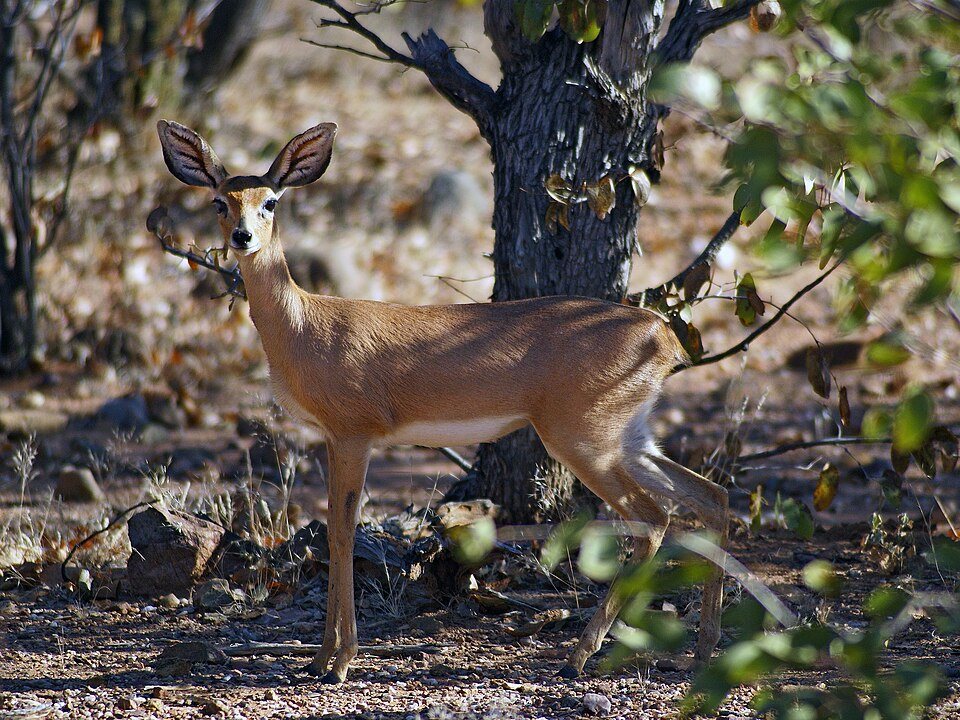
Photo: Hans Hillewaert · CC BY-SA 4.0 (May be cropped or resized)
Raphicerus campestris
Conservation status: Unknown
Basic stats
Diet
Low browse, forbs, roots, tubers and fruit; rarely grass
Habitat
Semi-desert, open woodland, thickets, open plains and acacia–grassland mosaics
Range
Eastern and southern Africa
Litter size
1 calf
Gestation period
About 197 days (AnAge)
Size
Shoulder height 45–60cm
Weight
7–16kg
The steenbok is a common small antelope of southern and eastern Africa that resembles a small oribi. It stands 45–60cm at the shoulder and weighs 7–16kg. The coat ranges from fawn to rufous, typically orange, and the underside, chin, throat and eye ring are white. The ears are large, there is a black crescent between them, a long black bridge runs to the glossy black nose, and a black scent gland sits before each eye. Males have straight, smooth, parallel horns of 7–19cm, and the tail is only 4–6cm (Wikipedia, general species account).
Steenbok live in habitats from semi-desert at the edge of the Kalahari and Etosha to open woodland, thickets and stony savanna. In central Kruger National Park they prefer Acacia tortilis savanna all year. They browse low vegetation, taking forbs and then woody plants, scrape up roots and tubers, take fruit and only rarely graze, and they get their moisture from food. They are active by day and night and rest in shade in the heat. Threatened animals lie low, then leap away in a zigzag (Wikipedia, general species account).
Where to see Steenbok in Kenya
GBIF records grouped by protected area. They show where the species has been reported, not that it is there now, and they are not population counts.
Recorded in 4 protected areas (2009–2026).
- Chyulu Hills: 13 records (2015)
- Masai Mara: 7 records (2009–2026)
- Tsavo West National Park: 3 records (2015)
- Ol Pejeta Conservancy: 3 records (2026)
Quick answers
- What does the Steenbok eat?
- Low browse, forbs, roots, tubers and fruit; rarely grass
- What habitat does the Steenbok live in?
- Semi-desert, open woodland, thickets, open plains and acacia–grassland mosaics
- Where is the Steenbok found?
- Eastern and southern Africa
- What is the litter size of the Steenbok?
- 1 calf
- How long is the gestation period of the Steenbok?
- About 197 days (AnAge)
- How big is the Steenbok?
- Shoulder height 45–60cm
- How much does the Steenbok weigh?
- 7–16kg