
 Wildlife
of Kenya
Olive Baboon
Primates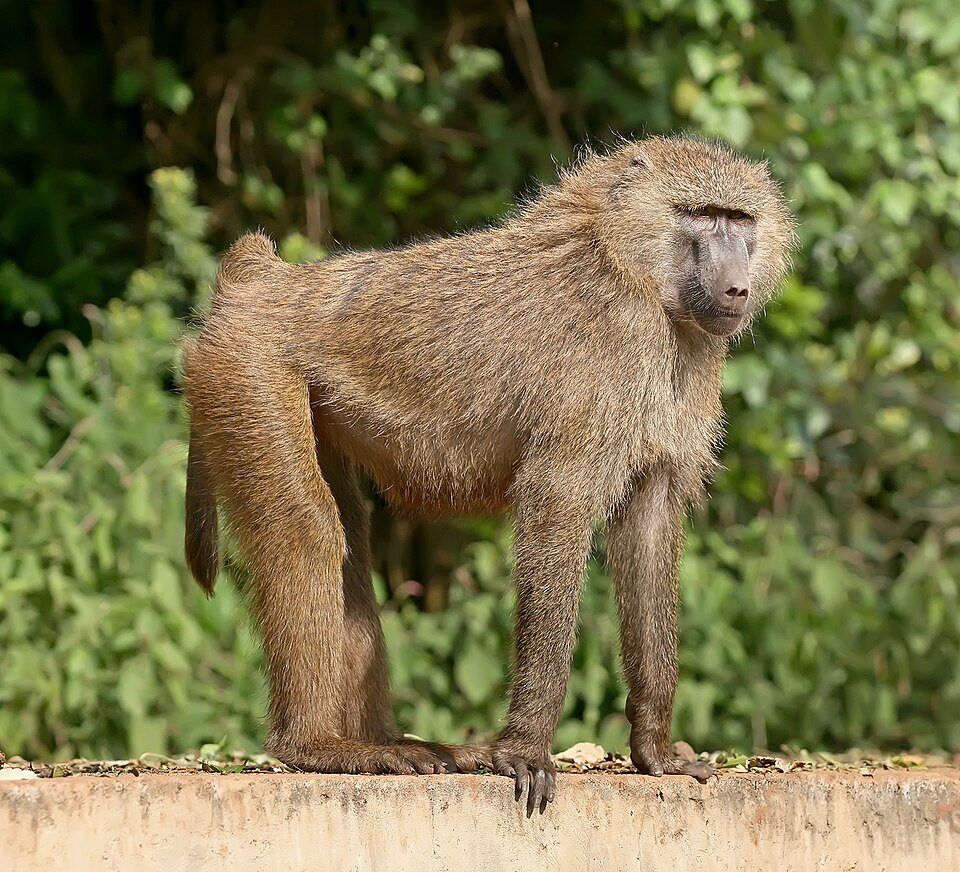
Photo: Muhammad Mahdi Karim · GFDL 1.2 (May be cropped or resized)
Papio anubis
Conservation status: Unknown
Basic stats
Diet
Omnivorous
Habitat
Savannah, steppe and forest; grassland near open woodland
Range
25 African countries from Mali east to Ethiopia and Tanzania; isolated populations in Saharan mountains
Litter size
1 young
Size
Head and body 50–114cm (average about 85cm); tail 38–58cm
Weight
10–37kg; males average 24kg, females 14.7kg
The olive baboon takes its name from its coat, which looks green-grey from a distance but is multicoloured up close, with rings of yellow-brown and black on each hair. The face hair is coarser and dark grey to black. It has a long, dog-like muzzle, a four-legged gait, and a tail 38–58 cm long that stands erect for its first quarter and then drops sharply. Males have a mane of longer hair; they average 70 cm at the shoulder and 24 kg, against 55 cm and 14.7 kg for females. Head and body range from 50 to 114 cm (Wikipedia, general species account). Another name is Anubis Baboon.
It is the most wide-ranging of all baboons, native to 25 countries from Mali east to Ethiopia and Tanzania, with isolated populations in some mountainous parts of the Sahara. It is usually classified as savannah-dwelling, living on wide grassland plains especially near open woodland, but it also inhabits steppes and forests. Its range overlaps those of other baboons, and hybridisation has been recorded, notably with the hamadryas baboon in Ethiopia and also with yellow and Guinea baboons. It has cheek pouches for storing food and a complex social structure supported by vocal and non-vocal communication (Wikipedia, general species account).
Where to see Olive Baboon in Kenya
GBIF records grouped by protected area. They show where the species has been reported, not that it is there now, and they are not population counts.
Recorded in 19 protected areas (1899–2026). The 8 with the most records:
- Lake Nakuru National Park: 149 records (1989–2026)
- Masai Mara: 43 records (1989–2026)
- Nairobi National Park: 28 records (1987–2026)
- Buffalo Springs National Reserve: 22 records (2003–2026)
- Mpala Ranch: 17 records (2011–2025)
- Samburu National Reserve: 14 records (2017–2026)
- Ol Jogi Conservancy: 12 records (2011–2025)
- Mara Triangle: 11 records (2015–2025)
Quick answers
- What does the Olive Baboon eat?
- Omnivorous
- What habitat does the Olive Baboon live in?
- Savannah, steppe and forest; grassland near open woodland
- Where is the Olive Baboon found?
- 25 African countries from Mali east to Ethiopia and Tanzania; isolated populations in Saharan mountains
- What is the litter size of the Olive Baboon?
- 1 young
- How big is the Olive Baboon?
- Head and body 50–114cm (average about 85cm); tail 38–58cm
- How much does the Olive Baboon weigh?
- 10–37kg; males average 24kg, females 14.7kg