
 Wildlife
of Kenya
Greater Painted-Snipe
Plovers, Sandpipers & Other Waders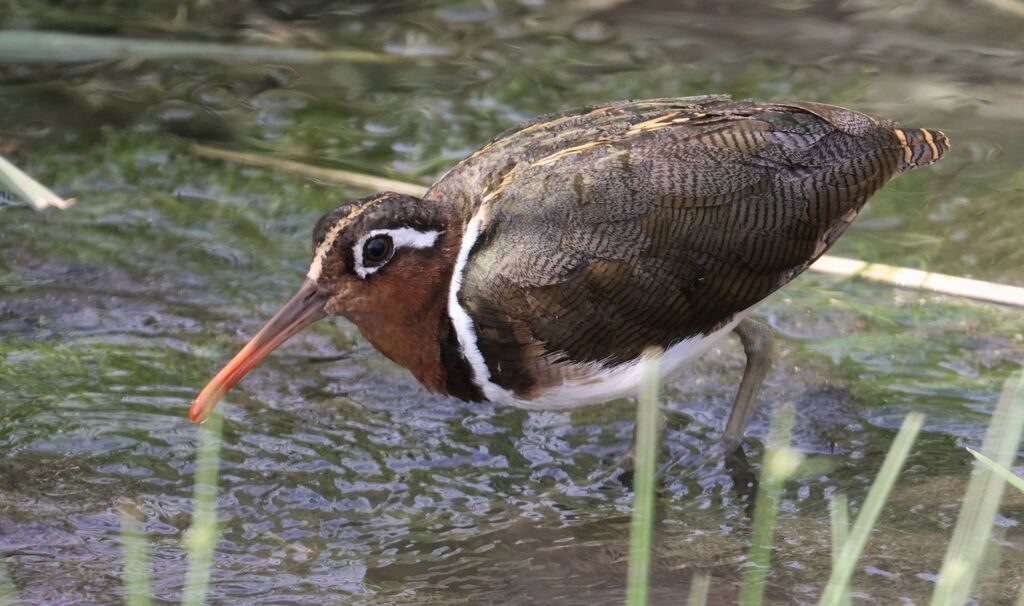
Photo: Alan Manson · CC BY 4.0 (May be cropped or resized)
Rostratula benghalensis
Conservation status: Unknown
Basic stats
Diet
Invertebrates and seeds
Habitat
Muddy wetlands with nearby reeds or other cover
Range
Sub-Saharan Africa, Madagascar, South Asia and Southeast Asia
Clutch size
Usually 4 eggs
Incubation period
About 19 days
Size
23–28cm
Weight
Averages about 121g
The Greater Painted-Snipe is a 23–28 cm wetland bird in which the female is larger and more vividly patterned than the male. She has a dark head, buff crown stripe, white eye patch and rich rufous neck, while the male is paler and more heavily barred. Both carry a curved white shoulder stripe over dark bronze-green upperparts. Juveniles resemble subdued males (Wikipedia, general species account).
The species occurs widely through sub-Saharan Africa, Madagascar, South Asia and Southeast Asia, favouring muddy shallows close to reeds or other shelter. It sweeps its bill through shallow water and soft sediment for insects, snails, worms and crustaceans, while seeds also form a substantial dietary component (Wikipedia, general species account; EltonTraits, Wilman et al. 2014). Females may mate with several males; each male incubates a clutch, usually four eggs, for about 19 days and tends the mobile chicks (Wikipedia, general species account).
Where to see Greater Painted-Snipe in Kenya
GBIF records grouped by protected area. They show where the species has been reported, not that it is there now, and they are not population counts.
Recorded in 20 protected areas (1973–2025). The 8 with the most records:
- Masai Mara: 112 records (1987–2024)
- Nairobi National Park: 83 records (1982–2024)
- Amboseli National Park: 69 records (1975–2025)
- Buffalo Springs National Reserve: 50 records (1989–2025)
- Lake Nakuru National Park: 47 records (1979–2024)
- Mara Triangle: 47 records (1994–2024)
- Tsavo East National Park: 44 records (2000–2024)
- Tsavo West National Park: 33 records (1988–2024)
Quick answers
- What does the Greater Painted-Snipe eat?
- Invertebrates and seeds
- What habitat does the Greater Painted-Snipe live in?
- Muddy wetlands with nearby reeds or other cover
- Where is the Greater Painted-Snipe found?
- Sub-Saharan Africa, Madagascar, South Asia and Southeast Asia
- How many eggs does the Greater Painted-Snipe lay?
- Usually 4 eggs
- How long are the eggs of the Greater Painted-Snipe incubated?
- About 19 days
- How big is the Greater Painted-Snipe?
- 23–28cm
- How much does the Greater Painted-Snipe weigh?
- Averages about 121g