
 Wildlife
of Kenya
Lesser Crested Tern
Plovers, Sandpipers & Other Waders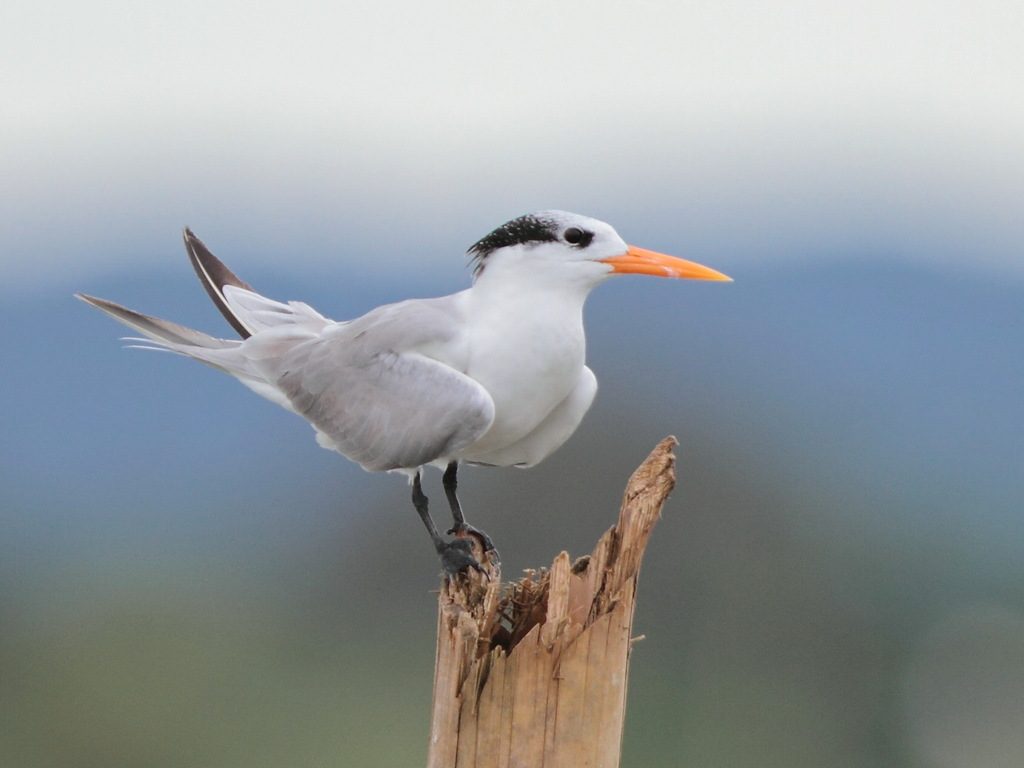
Photo: Ian Dugdale · CC BY 4.0 (May be cropped or resized)
Thalasseus bengalensis
Conservation status: Unknown
Basic stats
Diet
Fish
Habitat
Subtropical coasts, offshore islands and saline waters
Range
Breeds along warm coasts from the Mediterranean region east through the Indian Ocean, western Pacific and Australia; most populations migrate south
Clutch size
Usually 1–2 eggs
Size
35–43cm
Wingspan
88–105cm
Weight
Averages about 209g
The Lesser Crested Tern is a medium-large tern with a long, pointed orange bill, black legs and a shaggy black cap in breeding plumage. Its back, upperwings, rump and central tail are grey, while the underparts are white; the forehead turns white outside the breeding season. A grey rump helps distinguish it from several related terns. Adults measure 35–43 cm, span 88–105 cm and average about 209 g (Wikipedia, general species account; AVONET, Tobias et al. 2022).
The breeding distribution follows warm shorelines from the Mediterranean and Red Sea eastward through the Indian Ocean, western Pacific and Australia. Colonies pack densely onto islands and coasts. Australian birds are largely sedentary, while other populations move south, in some cases reaching southern Africa. Fish are caught by direct plunge-dives into saline water, and courtship includes males presenting fish to females. A shallow ground scrape normally contains one or two eggs, occasionally three (Wikipedia, general species account).
Where to see Lesser Crested Tern in Kenya
GBIF records grouped by protected area. They show where the species has been reported, not that it is there now, and they are not population counts.
Recorded in 8 protected areas (1969–2025).
- Watamu Marine National Park: 420 records (1969–2024)
- Mombasa Marine Reserve: 43 records (1977–2024)
- Diani-Chale Marine Reserve: 27 records (2006–2025)
- Tana Delta Community Conservancy: 18 records (1992–2024)
- Kisite-Mpunguti Marine National Park: 14 records (2005–2024)
- Arabuko-Sokoke Forest Reserve: 6 records (1982–2024)
- Lake Nakuru National Park: 5 records (2024)
- Malindi Marine National Park: 3 records (1984–2022)
Quick answers
- What does the Lesser Crested Tern eat?
- Fish
- What habitat does the Lesser Crested Tern live in?
- Subtropical coasts, offshore islands and saline waters
- Where is the Lesser Crested Tern found?
- Breeds along warm coasts from the Mediterranean region east through the Indian Ocean, western Pacific and Australia; most populations migrate south
- How many eggs does the Lesser Crested Tern lay?
- Usually 1–2 eggs
- How big is the Lesser Crested Tern?
- 35–43cm
- What is the wingspan of the Lesser Crested Tern?
- 88–105cm
- How much does the Lesser Crested Tern weigh?
- Averages about 209g