
 Wildlife
of Kenya
Gull-billed Tern
Plovers, Sandpipers & Other Waders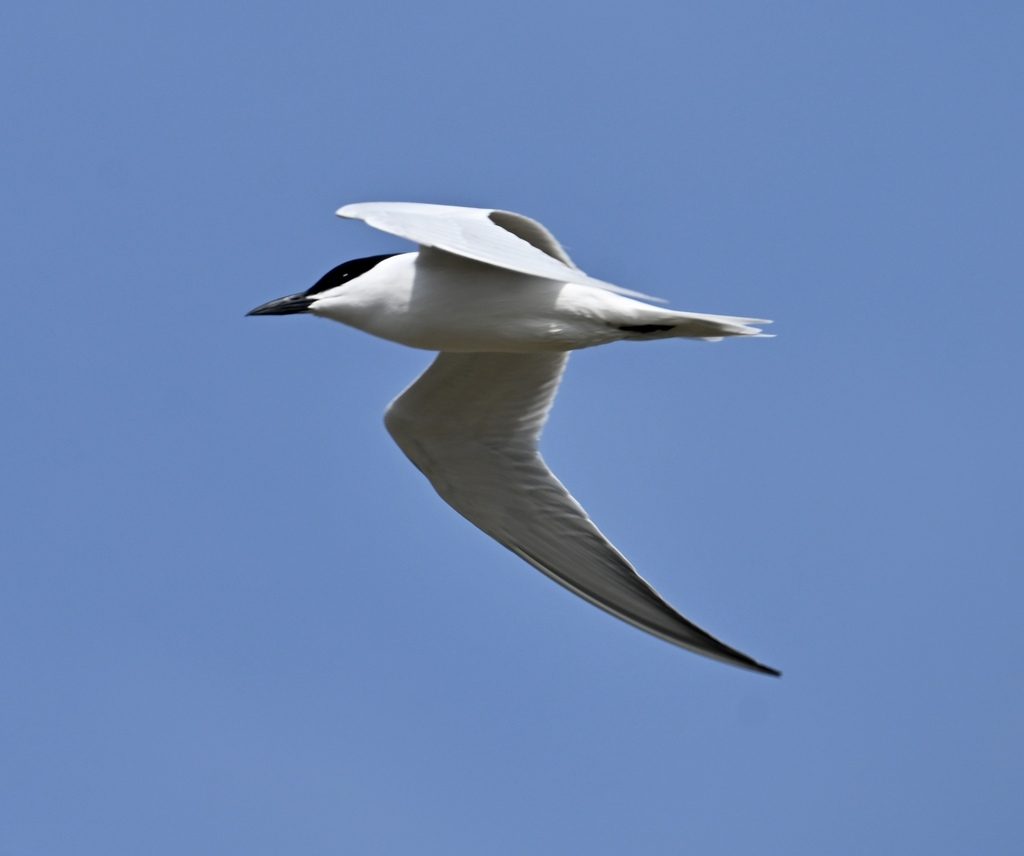
Photo: Amber M. King · CC BY 4.0 (May be cropped or resized)
Gelochelidon nilotica
Conservation status: Unknown
Basic stats
Diet
Insects and other invertebrates, small vertebrates and some aquatic prey
Habitat
Coasts, lagoons, salt marshes, lakes and open country near water
Range
Widely distributed in warm temperate and tropical regions of Europe, Africa, Asia, Australia and the Americas
Clutch size
Usually 3 eggs
Incubation period
About 22 days
Weight
Averages about 218g
The Gull-billed Tern is a robust, broad-winged tern with a thick black bill and comparatively long legs. Breeding adults have a black cap, pale grey upperparts and white underparts; the cap becomes streaked and reduced outside the breeding season. Its flight is less buoyant than that of many smaller terns, and the tail is only shallowly forked. Adults average about 218 g, making this a substantial member of the tern family (Wikipedia, general species account; AVONET, Tobias et al. 2022).
Across its broad warm-temperate and tropical range, the species uses coasts, lagoons, salt marshes, lakes and nearby open land. Unlike terns that rely chiefly on plunge-diving, it often hunts over marshes and fields, taking insects, crabs and small vertebrates from the ground or water surface. Colonies form on bare islands, beaches and similar open sites. A usual clutch contains three eggs, and incubation lasts about 22 days (Wikipedia, general species account; AnAge).
Where to see Gull-billed Tern in Kenya
GBIF records grouped by protected area. They show where the species has been reported, not that it is there now, and they are not population counts.
Recorded in 26 protected areas (1969–2026). The 8 with the most records:
- Lake Nakuru National Park: 996 records (1969–2026)
- Watamu Marine National Park: 681 records (1969–2025)
- Amboseli National Park: 239 records (1976–2024)
- Crescent Island Widlife Sanctuary: 146 records (1984–2024)
- Soysambu Conservancy: 101 records (1997–2024)
- Tsavo West National Park: 64 records (1981–2024)
- Tana Delta Community Conservancy: 51 records (1998–2024)
- Arabuko-Sokoke Forest Reserve: 37 records (1982–2024)
Quick answers
- What does the Gull-billed Tern eat?
- Insects and other invertebrates, small vertebrates and some aquatic prey
- What habitat does the Gull-billed Tern live in?
- Coasts, lagoons, salt marshes, lakes and open country near water
- Where is the Gull-billed Tern found?
- Widely distributed in warm temperate and tropical regions of Europe, Africa, Asia, Australia and the Americas
- How many eggs does the Gull-billed Tern lay?
- Usually 3 eggs
- How long are the eggs of the Gull-billed Tern incubated?
- About 22 days
- How much does the Gull-billed Tern weigh?
- Averages about 218g