
 Wildlife
of Kenya
Glossy Ibis
Storks, Herons, Ibises & Flamingos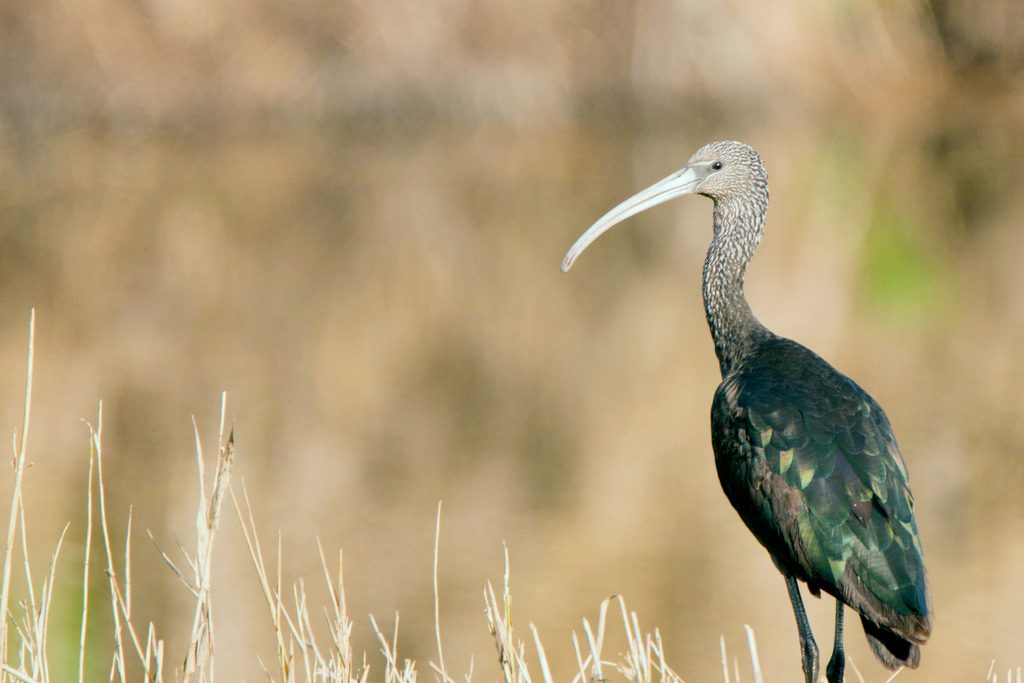
Photo: Atk3196 · CC BY-SA 4.0 (May be cropped or resized)
Plegadis falcinellus
Conservation status: Unknown
Basic stats
Diet
Mainly aquatic invertebrates, with small vertebrates and fish
Habitat
Freshwater marshes, lake and river margins, wet meadows, rice fields and coastal lagoons
Range
Europe, Asia, Africa and Australia, plus Atlantic and Caribbean parts of the Americas
Clutch size
Usually 3 eggs
Incubation period
About 21 days
Size
48–66cm
Wingspan
80–105cm
Weight
Averages about 627g
The Glossy Ibis has the broadest distribution of any ibis. Breeding populations occupy scattered warm-region wetlands across four Old World continents, as well as Atlantic and Caribbean portions of the Americas. Adults are deep reddish brown with glossy green, bronze or purple wings, a long down-curved bill and a narrow pale facial border. Non-breeding birds and juveniles are duller and show fine pale streaking on the head and neck. In flight, the neck remains extended. (Wikipedia, general species account)
The species probes wet soil and shallow water for food, with aquatic invertebrates dominating its recorded diet and small vertebrates and fish also taken. It uses freshwater marshes, vegetated lake and river margins, wet meadows, rice fields and coastal lagoons, and often nests in mixed-species colonies. Many populations migrate or disperse widely after breeding. AnAge records a typical clutch of three and incubation of about 21 days; AVONET gives mean mass as about 626.6 g. (EltonTraits, Wilman et al. 2014; AnAge; AVONET, Tobias et al. 2022; Wikipedia, general species account)
Where to see Glossy Ibis in Kenya
GBIF records grouped by protected area. They show where the species has been reported, not that it is there now, and they are not population counts.
Recorded in 41 protected areas (1965–2026). The 8 with the most records:
- Amboseli National Park: 1,535 records (1971–2026)
- Lake Nakuru National Park: 808 records (1969–2026)
- Nairobi National Park: 192 records (1973–2026)
- Crescent Island Widlife Sanctuary: 155 records (1973–2024)
- Tsavo West National Park: 72 records (1966–2024)
- Soysambu Conservancy: 67 records (1993–2024)
- Masai Mara: 55 records (1993–2024)
- Lake Bogoria National Reserve: 33 records (1995–2024)
Quick answers
- What does the Glossy Ibis eat?
- Mainly aquatic invertebrates, with small vertebrates and fish
- What habitat does the Glossy Ibis live in?
- Freshwater marshes, lake and river margins, wet meadows, rice fields and coastal lagoons
- Where is the Glossy Ibis found?
- Europe, Asia, Africa and Australia, plus Atlantic and Caribbean parts of the Americas
- How many eggs does the Glossy Ibis lay?
- Usually 3 eggs
- How long are the eggs of the Glossy Ibis incubated?
- About 21 days
- How big is the Glossy Ibis?
- 48–66cm
- What is the wingspan of the Glossy Ibis?
- 80–105cm
- How much does the Glossy Ibis weigh?
- Averages about 627g