
 Wildlife
of Kenya
Greater Flamingo
Storks, Herons, Ibises & Flamingos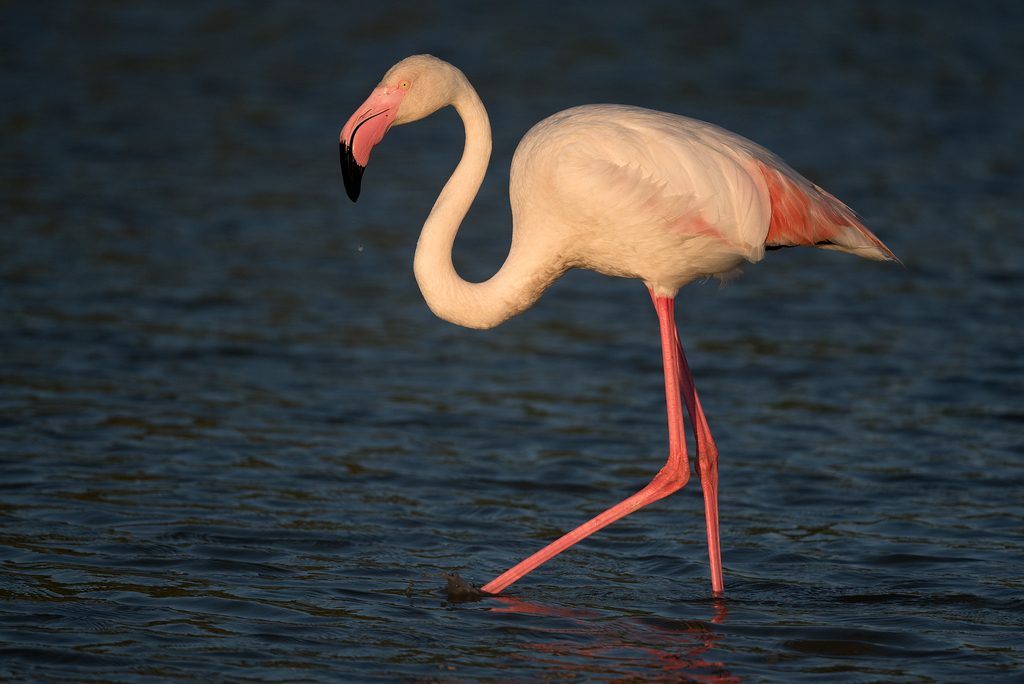
Photo: Pierre-Marie Epiney · CC BY-SA 4.0 (May be cropped or resized)
Phoenicopterus roseus
Conservation status: Unknown
Basic stats
Diet
Aquatic invertebrates, seeds, plant matter and small fish
Habitat
Wetlands
Range
Africa, southern Europe, the Middle East, Central Asia and the Indian subcontinent
Clutch size
1 egg
Incubation period
30 days
Size
110–150cm tall
Weight
Averages about 3kg
The Greater Flamingo is the largest flamingo, standing about 110–150 cm tall. Adults are mostly pinkish white, with red wing coverts, black flight feathers, an entirely pink leg and a pink bill ending in a restricted black tip. Grey, downy chicks and paler subadults gradually acquire adult colours. Carotenoid pigments obtained through feeding contribute to the pink plumage (Wikipedia, general species account).
Across Africa, southern Europe, western and central Asia and the Indian subcontinent, the species inhabits wetlands and feeds on aquatic invertebrates, seeds, plant material and some small fish (EltonTraits, Wilman et al. 2014). Breeding birds form colonies and lay one chalky-white egg on a raised mud mound. Adults give goose-like honks, and movements vary among populations rather than following one uniform migratory pattern (Wikipedia, general species account; AVONET, Tobias et al. 2022).
Where to see Greater Flamingo in Kenya
GBIF records grouped by protected area. They show where the species has been reported, not that it is there now, and they are not population counts.
Recorded in 24 protected areas (1963–2026). The 8 with the most records:
- Lake Nakuru National Park: 1,975 records (1963–2026)
- Amboseli National Park: 1,178 records (1969–2026)
- Watamu Marine National Park: 404 records (1973–2026)
- Lake Bogoria National Reserve: 327 records (1980–2024)
- Soysambu Conservancy: 295 records (1969–2024)
- Crescent Island Widlife Sanctuary: 45 records (1984–2024)
- Kiturua Conservancy: 25 records (2014–2024)
- Ol Kelunyiet Conservancy: 23 records (2021–2024)
Quick answers
- What does the Greater Flamingo eat?
- Aquatic invertebrates, seeds, plant matter and small fish
- What habitat does the Greater Flamingo live in?
- Wetlands
- Where is the Greater Flamingo found?
- Africa, southern Europe, the Middle East, Central Asia and the Indian subcontinent
- How many eggs does the Greater Flamingo lay?
- 1 egg
- How long are the eggs of the Greater Flamingo incubated?
- 30 days
- How big is the Greater Flamingo?
- 110–150cm tall
- How much does the Greater Flamingo weigh?
- Averages about 3kg