
 Wildlife
of Kenya
Hadada Ibis
Storks, Herons, Ibises & Flamingos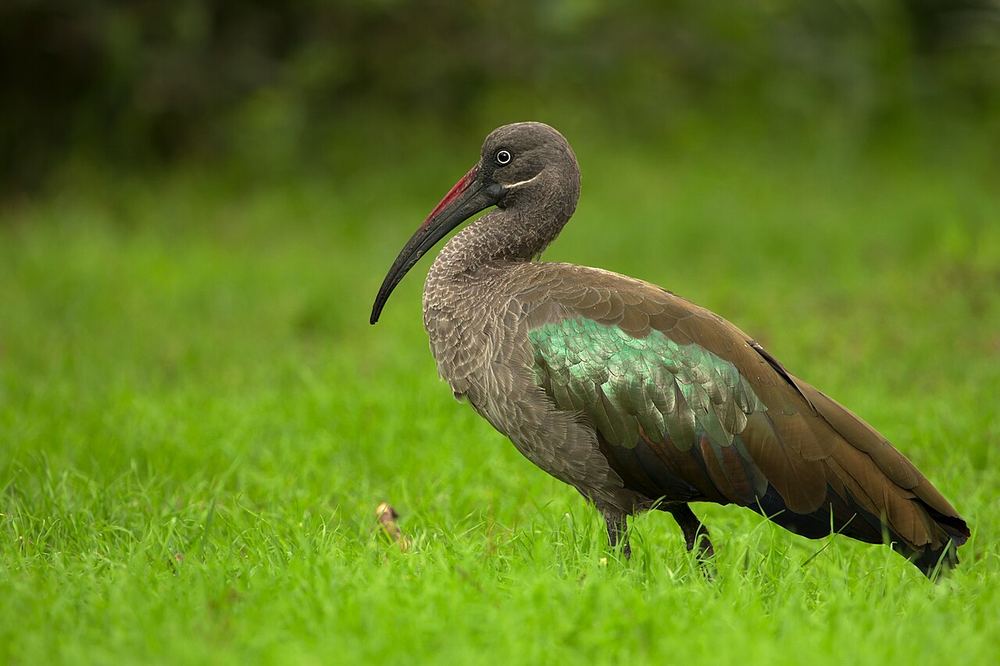
Photo: Sumeet Moghe · CC BY-SA 3.0 (May be cropped or resized)
Bostrychia hagedash
Conservation status: Unknown
Basic stats
Diet
Insects, earthworms and other small animals
Habitat
Grassland, wetlands and cultivated areas
Range
Sub-Saharan Africa
Clutch size
3–4 eggs
Incubation period
About 26 days
Size
About 76cm
Weight
Average 1,238g
The Hadada Ibis lives across sub-Saharan Africa in grassland, savanna and wetlands, as well as cultivated areas and gardens. About 76 cm long, it is grey-brown with a narrow white cheek stripe and iridescent wing coverts. Its long bill curves downward. Loud calls often accompany flights to and from communal tree roosts. AVONET gives an average mass of 1,238 g (Wikipedia, general species account; AVONET, Tobias et al. 2022).
The ibis probes soft soil for earthworms, insects, millipedes and other small prey. It nests as a pair on a platform of twigs, typically in the fork of a large tree. Both parents incubate three or four eggs for about 26 days and feed the young by regurgitation. The surviving young fledge at around 33 days (Wikipedia, general species account).
Where to see Hadada Ibis in Kenya
GBIF records grouped by protected area. They show where the species has been reported, not that it is there now, and they are not population counts.
Recorded in 143 protected areas (1965–2026). The 8 with the most records:
- Nairobi National Park: 2,573 records (1973–2026)
- Masai Mara: 1,901 records (1971–2026)
- Lake Nakuru National Park: 1,606 records (1969–2026)
- Kagamega Forest: 868 records (1984–2025)
- Amboseli National Park: 823 records (1973–2026)
- Mara Triangle: 636 records (1971–2026)
- Samburu National Reserve: 586 records (1979–2026)
- Mount Kenya National Reserve: 554 records (1977–2024)
Quick answers
- What does the Hadada Ibis eat?
- Insects, earthworms and other small animals
- What habitat does the Hadada Ibis live in?
- Grassland, wetlands and cultivated areas
- Where is the Hadada Ibis found?
- Sub-Saharan Africa
- How many eggs does the Hadada Ibis lay?
- 3–4 eggs
- How long are the eggs of the Hadada Ibis incubated?
- About 26 days
- How big is the Hadada Ibis?
- About 76cm
- How much does the Hadada Ibis weigh?
- Average 1,238g