
 Wildlife
of Kenya
Yellow Baboon
Primates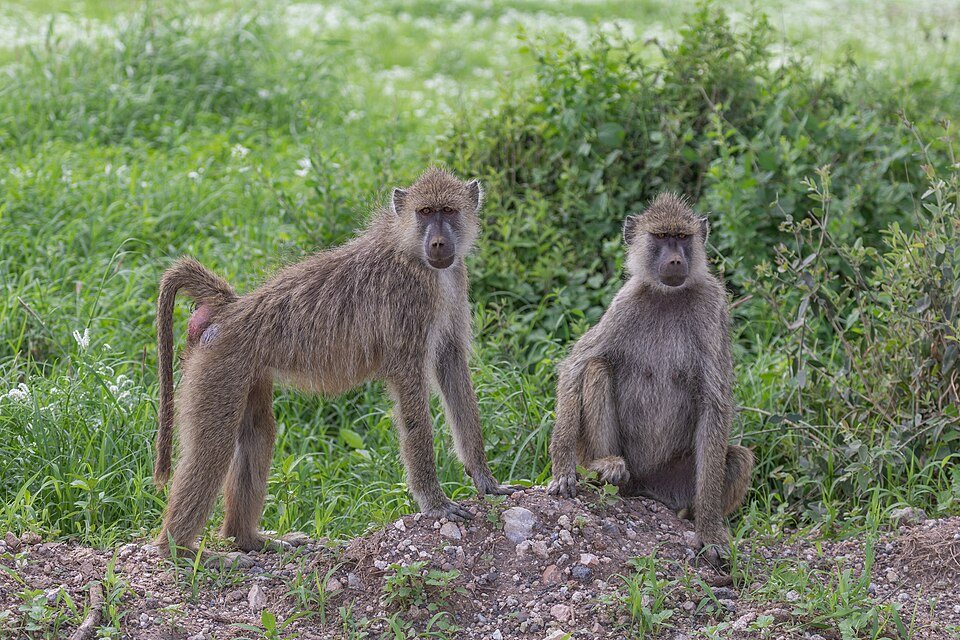
Photo: Ninara · CC BY 2.0 (May be cropped or resized)
Papio cynocephalus
Conservation status: Unknown
Basic stats
Diet
Fruit preferred; also leaves, seeds, grasses, bulbs, bark, blossoms, fungi, invertebrates, birds and small mammals
Habitat
Miombo woodland, dry bushland, thickets, steppe and coastal mangroves, near fresh water
Range
Eastern Africa, from Kenya and Tanzania to Zimbabwe and Botswana
Litter size
1 young
Gestation period
About 180 days
The yellow baboon has a slim body, long arms and legs, a long tail nearly as long as the body and yellowish-brown hair. Its hairless black face is framed by white sideburns. It resembles the chacma baboon but is somewhat smaller, with a less elongated muzzle; the species name means dog-head in Greek, after the dog-like shape of the muzzle and head. The wild life span is roughly 15–20 years, with some reaching 30 (Wikipedia, general species account). Another name is Northern Yellow Baboon (GBIF vernacular names).
It is diurnal and mainly terrestrial, living in mostly fire-maintained miombo woodland, dry bushland, thickets, steppe and coastal mangroves provided fresh water is available, and it persists in fragmented vegetation and cultivated areas. Groups of 20–80 are multimale-multifemale, with more females than males; males leave their natal group at 7–13 years while females stay and form linear dominance hierarchies. Movements are under 4 km a day when food is plentiful and 8–10 km in the dry season, and groups usually sleep in trees. Gestation is about 180 days, and females have their first infant at about six years (GBIF description, Cercopithecidae).
Where to see Yellow Baboon in Kenya
GBIF records grouped by protected area. They show where the species has been reported, not that it is there now, and they are not population counts.
Recorded in 11 protected areas (1965–2026). The 8 with the most records:
- Amboseli National Park: 38 records (1989–2026)
- Chyulu Hills: 22 records (2015–2022)
- Tsavo West National Park: 17 records (1989–2025)
- Tsavo East National Park: 12 records (1989–2026)
- Shimba Hills National Reserve: 6 records (2013–2022)
- Kari Ranch: 5 records (2015)
- Arabuko-Sokoke Forest Reserve: 4 records (1965–2023)
- Taita Hills Wildlife Sanctuary: 4 records (2003–2016)
Quick answers
- What does the Yellow Baboon eat?
- Fruit preferred; also leaves, seeds, grasses, bulbs, bark, blossoms, fungi, invertebrates, birds and small mammals
- What habitat does the Yellow Baboon live in?
- Miombo woodland, dry bushland, thickets, steppe and coastal mangroves, near fresh water
- Where is the Yellow Baboon found?
- Eastern Africa, from Kenya and Tanzania to Zimbabwe and Botswana
- What is the litter size of the Yellow Baboon?
- 1 young
- How long is the gestation period of the Yellow Baboon?
- About 180 days