
 Wildlife
of Kenya
Red-tailed Monkey
Primates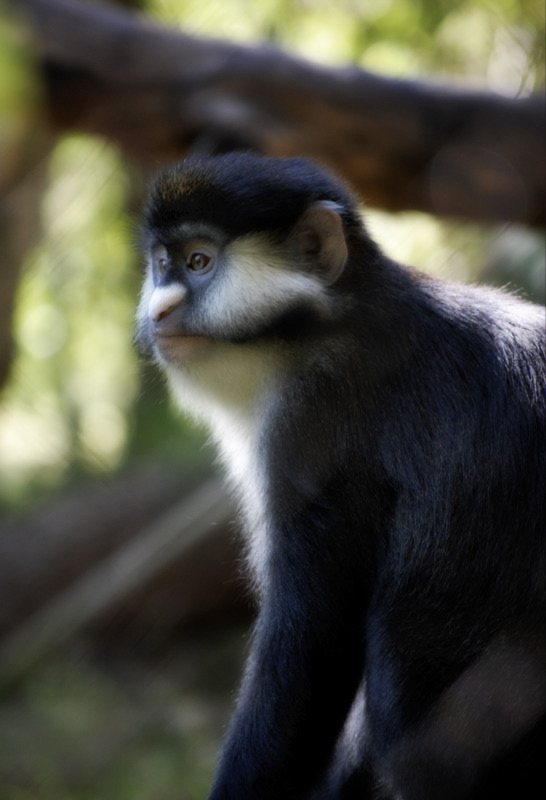
Photo: Denise · CC BY-SA 2.0 (May be cropped or resized)
Cercopithecus ascanius
Conservation status: Unknown
Basic stats
Diet
Mainly fruit, plus seeds, leaves and invertebrates
Habitat
Lowland to montane forest, wet and dry, gallery, swamp and secondary forest, up to 2500m
Range
Central and East Africa, including Angola, Central African Republic, DR Congo, Kenya, Rwanda, South Sudan, Tanzania, Uganda and Zambia
Litter size
1 infant
Gestation period
5–6 months
Size
Head and body 43–56cm (males), 34–48.5cm (females); tail 60–92cm and 54–79cm
Weight
3–6kg (males), 1.8–4kg (females)
The red-tailed monkey has an agouti-brown back, a light underside and inner limbs, and a tail that is at least partly red with a black tip, the red deepening toward the tip. A conspicuous heart-shaped nose spot is white, yellow, red or black depending on the subspecies, and white cheek whiskers radiate from a whorl in front of the ears. The skin around the eyes is slate blue or black, and the cheeks are large and elastic for storing food. Males measure 43–56 cm and weigh 3–6 kg, females 34–48.5 cm and 1.8–4 kg (GBIF description, Cercopithecidae; Wikipedia, general species account). Other names include Red-tailed Guenon, Redtail Monkey and Schmidt's Guenon.
Diurnal and arboreal, it spends 60–90 percent of its time 5–20 m above the ground. It lives in hierarchical, male-dominated groups of one male and several females, averaging 30–35 animals, and a Kibale Forest study found groups splitting at about 50. Home ranges are 15–68 ha, and Schmidt's red-tailed monkeys travel 1,400–1,900 m a day. Gestation is 5–6 months with a single young, and mating occurs through the year. Habitat runs from lowland to montane, wet and dry forest, usually near rivers, from sea level to 2,500 m, including disturbed forest and farmland (GBIF description, Cercopithecidae).
Quick answers
- What does the Red-tailed Monkey eat?
- Mainly fruit, plus seeds, leaves and invertebrates
- What habitat does the Red-tailed Monkey live in?
- Lowland to montane forest, wet and dry, gallery, swamp and secondary forest, up to 2500m
- Where is the Red-tailed Monkey found?
- Central and East Africa, including Angola, Central African Republic, DR Congo, Kenya, Rwanda, South Sudan, Tanzania, Uganda and Zambia
- What is the litter size of the Red-tailed Monkey?
- 1 infant
- How long is the gestation period of the Red-tailed Monkey?
- 5–6 months
- How big is the Red-tailed Monkey?
- Head and body 43–56cm (males), 34–48.5cm (females); tail 60–92cm and 54–79cm
- How much does the Red-tailed Monkey weigh?
- 3–6kg (males), 1.8–4kg (females)