
 Wildlife
of Kenya
Heart-nosed False-vampire
Bats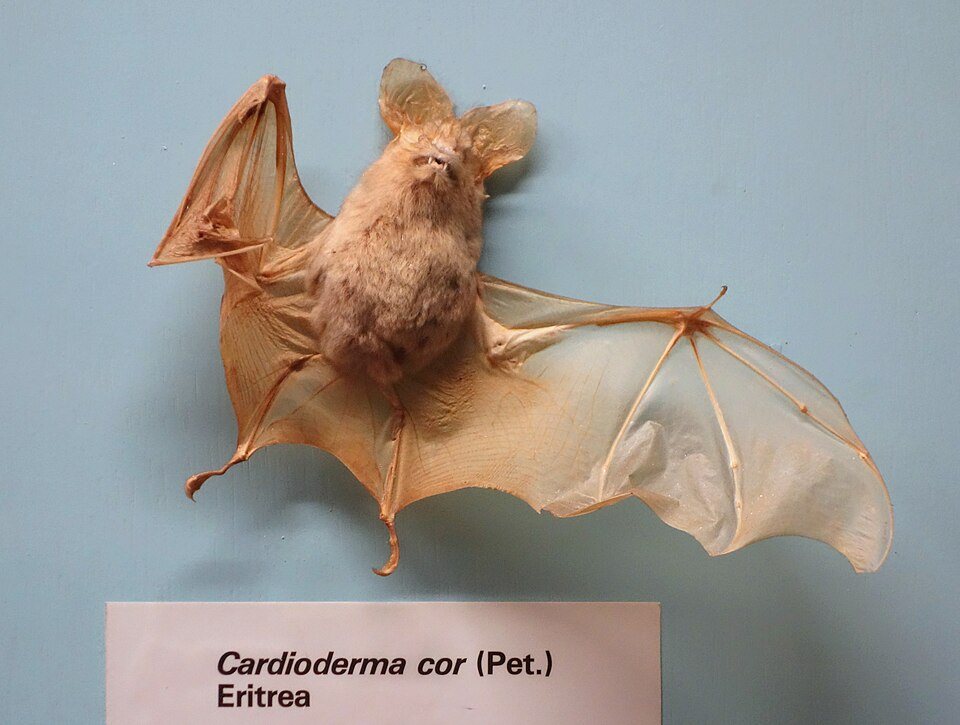
Photo: Daderot · CC0
Cardioderma cor
Conservation status: Unknown
Basic stats
Diet
Insects, caught by hawking or sit-and-wait
Habitat
Dry lowlands, coastal strips and river valleys; roosts in buildings, caves and baobabs
Range
Eastern Sudan, north Tanzania and south Zambia
Size
Length 70–77mm
Weight
21–35g
The heart-nosed bat is the sole species of the genus Cardioderma within the family Megadermatidae. It weighs 21–35g and measures 70–77mm long, with long, loose blueish-grey fur and no tail, unlike most other bats. Its skull, teeth and heart-shaped nose are its most recognisable features. Its territorial songs, which a 2017 experiment showed are used to mark foraging areas and deter rivals, are another notable trait (Wikipedia, general species account).
It lives in dry lowlands, coastal strips and river valleys up to 940m, sheltering by day in abandoned buildings, dry caves or baobab trees. Colonies can be large, yet the bats are very territorial and do not mix with other species. They leave roost shortly before sunset and hunt insects either by hawking in flight or by sit-and-wait from a perch, the latter mainly in the dry season. Breeding pairs often stay together across several seasons, with males guarding the breeding site. One pup is born after a three-month gestation, is carried for two months, and is weaned after the third month, learning about foraging and territories from its mother (Wikipedia, general species account).
Where to see Heart-nosed False-vampire in Kenya
GBIF records grouped by protected area. They show where the species has been reported, not that it is there now, and they are not population counts.
Recorded in 13 protected areas (1963–2024). The 8 with the most records:
- Tsavo West National Park: 81 records (1964–2012)
- Buffalo Springs National Reserve: 55 records (2008–2013)
- Osewan Wildlife Conservancy: 31 records (1984)
- Kasigau Conservancy: 24 records (2006)
- Rukinga Conservancy: 10 records (2006)
- Meru National Park: 9 records (2012–2013)
- Mount Kenya National Park: 7 records (1968)
- Arabuko-Sokoke Forest Reserve: 7 records (2006)
Quick answers
- What does the Heart-nosed False-vampire eat?
- Insects, caught by hawking or sit-and-wait
- What habitat does the Heart-nosed False-vampire live in?
- Dry lowlands, coastal strips and river valleys; roosts in buildings, caves and baobabs
- Where is the Heart-nosed False-vampire found?
- Eastern Sudan, north Tanzania and south Zambia
- How big is the Heart-nosed False-vampire?
- Length 70–77mm
- How much does the Heart-nosed False-vampire weigh?
- 21–35g