
 Wildlife
of Kenya
Hamadryas Baboon
Primates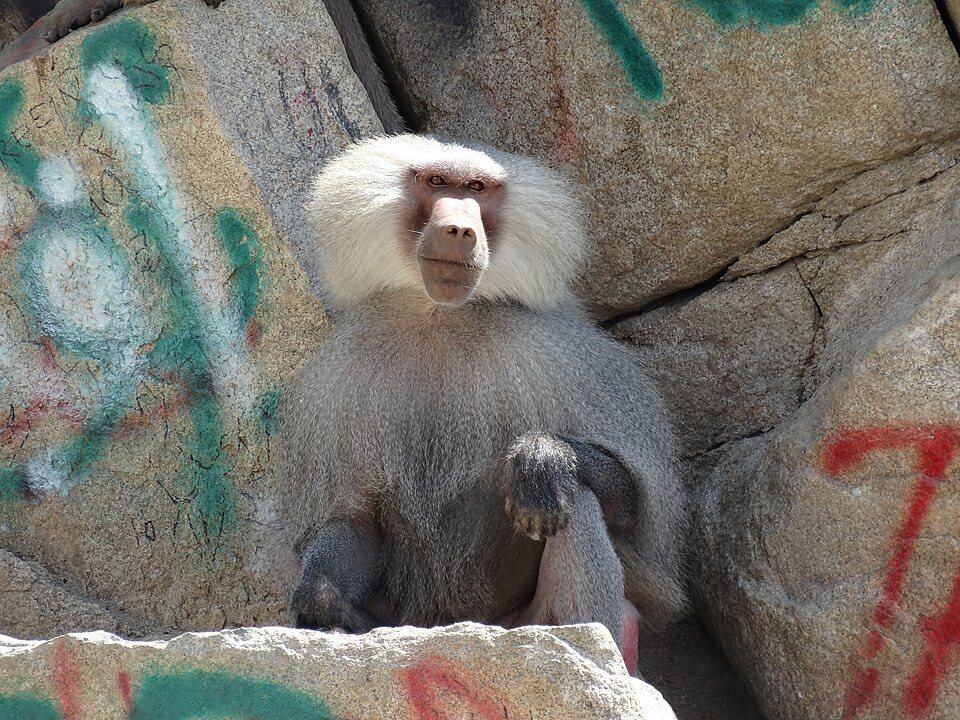
Photo: Nick Shields · CC BY 2.0 (May be cropped or resized)
Papio hamadryas
Conservation status: Unknown
Basic stats
Diet
Blossoms, fruits, seeds, grasses, roots, tubers, bark, gums and leaves; also eggs, insects, reptiles, birds and small mammals
Habitat
Rocky desert and semi-desert steppe, arid lowland savanna and cliffs to 2600m; needs water and cliffs for sleeping
Range
Horn of Africa and southwest Arabian Peninsula
Litter size
1 young
Size
Males up to 80cm; females 40–45cm; tail 40–60cm
Weight
Males 20–30kg; females 10–15kg
The hamadryas baboon is the northernmost baboon, native to the Horn of Africa and southwest Arabia, and was sacred to the ancient Egyptians. Adult males develop a pronounced silver-white mane and mantle at about ten years, while females are brown all over with reddish to dark brown faces and no cape. Males are nearly twice as large as females, up to 80 cm long and 20–30 kg against 40–45 cm and 10–15 kg; the tail adds 40–60 cm and ends in a small tuft. Infants are very dark brown or black and lighten after about a year (Wikipedia, general species account). Other names include Sacred Baboon and Mantled Baboon.
It is diurnal and terrestrial, living in rocky desert, semi-desert steppe, arid lowland savanna and cliff faces to 2,600 m, and is never found far from water; groups may move up to 3,300 m in the Simien Mountains in the wet season. Nights are spent on steep rocky cliffs. The multilevel society has one-male units of a leader male with typically 2–3 females, which join into clans and bands of over 100. Home ranges are 10–40 km² and daily movements usually 6–8 km. It is omnivorous, shifting with the seasons from blossoms, fruit, seeds and roots to Dobera glabra and sisal leaves in the dry months (GBIF description, Cercopithecidae; Wikipedia, general species account).
Quick answers
- What does the Hamadryas Baboon eat?
- Blossoms, fruits, seeds, grasses, roots, tubers, bark, gums and leaves; also eggs, insects, reptiles, birds and small mammals
- What habitat does the Hamadryas Baboon live in?
- Rocky desert and semi-desert steppe, arid lowland savanna and cliffs to 2600m; needs water and cliffs for sleeping
- Where is the Hamadryas Baboon found?
- Horn of Africa and southwest Arabian Peninsula
- What is the litter size of the Hamadryas Baboon?
- 1 young
- How big is the Hamadryas Baboon?
- Males up to 80cm; females 40–45cm; tail 40–60cm
- How much does the Hamadryas Baboon weigh?
- Males 20–30kg; females 10–15kg