
 Wildlife
of Kenya
Golden-rumped Sengi
Aardvark & Elephant Shrews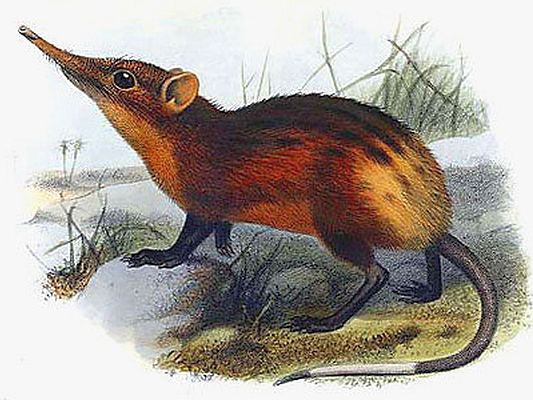
Photo: Joseph Smit · Public domain
Rhynchocyon chrysopygus
Conservation status: Unknown
Basic stats
Diet
Mainly invertebrates such as earthworms, millipedes, insects and spiders
Habitat
Dense coastal, moist and lowland semi-deciduous forests
Range
Southern coastal Kenya, from the Tana River to near Mombasa
Gestation period
About 42 days
Size
Head-body 218–304mm, tail 213–270mm
Weight
410–690g
The golden-rumped sengi, also called the golden rumped elephant shrew, is a small African mammal and the largest member of the sengi family Macroscelididae, alongside the grey-faced sengi. It has rufous, red-brown fur, bright yellow hair on the rump, and black, nearly hairless pinnae. Its tail is about 85% of head-body length and tapers toward the tip, and it weighs 410–690g. The rump has thick skin and a dermal shield roughly three times thicker than the skin mid-back, which can draw a predator's attack away from the head (Wikipedia, general species account; GBIF description, Macroscelididae).
It is diurnal and lives in densely vegetated forest, avoiding open ground, in coastal regions as well as moist dense-brush and lowland semi-deciduous forests. It feeds mainly on invertebrates such as earthworms, millipedes and insects, and it can run up to 25km/h. Monogamous pairs share a defended territory, though pair bonds are weak and each member nests separately, with both sexes marking territory using scent glands. Gestation is roughly 42 days, and newborns stay in the nest for about two weeks. Sources differ on litter size, with Wikipedia giving one young and GBIF one to two, so no litter size is given (Wikipedia, general species account; GBIF description, Macroscelididae).
Quick answers
- What does the Golden-rumped Sengi eat?
- Mainly invertebrates such as earthworms, millipedes, insects and spiders
- What habitat does the Golden-rumped Sengi live in?
- Dense coastal, moist and lowland semi-deciduous forests
- Where is the Golden-rumped Sengi found?
- Southern coastal Kenya, from the Tana River to near Mombasa
- How long is the gestation period of the Golden-rumped Sengi?
- About 42 days
- How big is the Golden-rumped Sengi?
- Head-body 218–304mm, tail 213–270mm
- How much does the Golden-rumped Sengi weigh?
- 410–690g