
 Wildlife
of Kenya
Common Slender Mongoose
Hyenas, Mongooses, Civets & Mustelids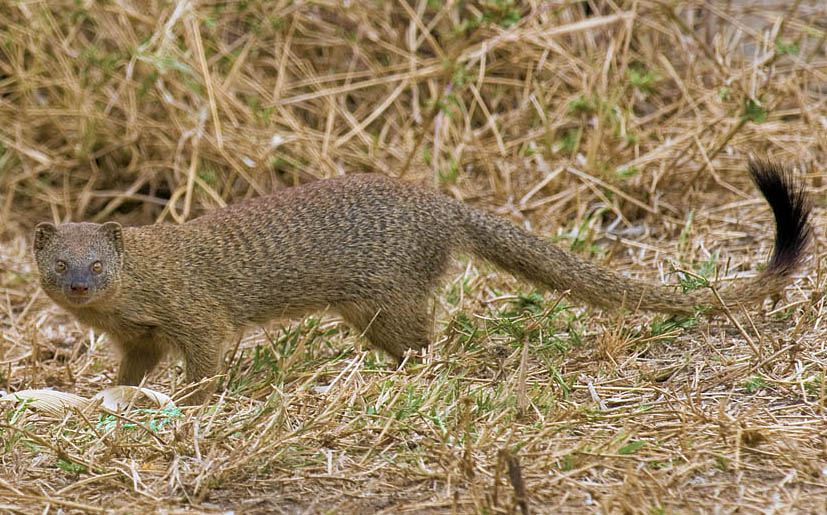
Photo: Yathin S Krishnappa · CC BY-SA 3.0 (May be cropped or resized)
Herpestes sanguineus
Conservation status: Unknown
Basic stats
Diet
Mostly insects; also lizards, rodents, snakes, birds, eggs, carrion and some fruit
Habitat
Savanna and semi-arid plains; absent from true desert
Range
Sub-Saharan Africa
Litter size
1–3
Gestation period
About 60–70 days
Size
Body 27.5–40cm; tail 23–33cm
Weight
640–715g (males), 460–575g (females)
The common slender mongoose is a lithe mongoose with a body of 27.5–40cm and a long tail of 23–33cm. Males weigh 640–715g and the smaller females 460–575g. Fur colour varies widely between subspecies, from dark reddish-brown through orange-red and gray to golden yellow, but the prominent black or red tail tip is distinctive. The fur is silkier than that of other African mongooses (Wikipedia, general species account).
It occurs throughout sub-Saharan Africa, mostly in arid and semi-arid areas such as savanna and semi-arid plains, and is rarely found in dense forest or true desert. It is mainly diurnal and often solitary, though in the Kalahari small groups den together on some nights. Insects make up the bulk of the diet, with lizards, rodents, snakes, birds and fruit also eaten, and it can kill venomous snakes. Gestation is about 60–70 days and litters hold one to three young (Wikipedia, general species account; GBIF description, Herpestidae).
Where to see Common Slender Mongoose in Kenya
GBIF records grouped by protected area. They show where the species has been reported, not that it is there now, and they are not population counts.
Recorded in 4 protected areas (1906–2025).
- Mount Kenya National Park: 6 records (1906–1950)
- Aberdare National Park: 5 records (2024–2025)
- Tsavo West National Park: 3 records (2024–2025)
- Mpala Ranch: 3 records (2017–2019)
Quick answers
- What does the Common Slender Mongoose eat?
- Mostly insects; also lizards, rodents, snakes, birds, eggs, carrion and some fruit
- What habitat does the Common Slender Mongoose live in?
- Savanna and semi-arid plains; absent from true desert
- Where is the Common Slender Mongoose found?
- Sub-Saharan Africa
- What is the litter size of the Common Slender Mongoose?
- 1–3
- How long is the gestation period of the Common Slender Mongoose?
- About 60–70 days
- How big is the Common Slender Mongoose?
- Body 27.5–40cm; tail 23–33cm
- How much does the Common Slender Mongoose weigh?
- 640–715g (males), 460–575g (females)