
 Wildlife
of Kenya
African Palm Civet
Hyenas, Mongooses, Civets & Mustelids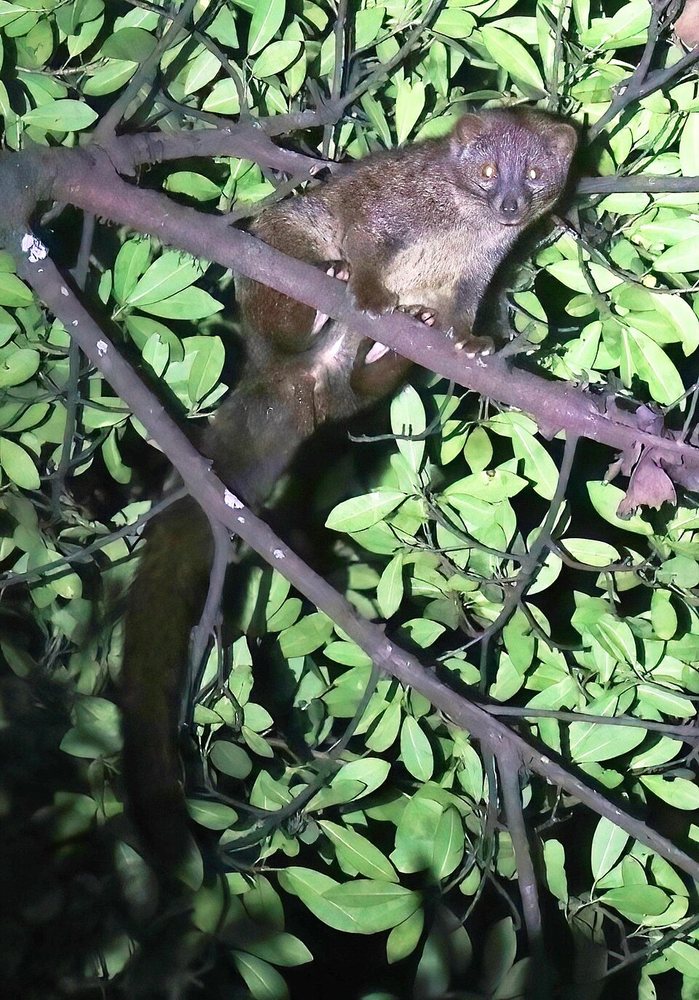
Photo: Thomas Galewski · CC BY 4.0 (May be cropped or resized)
Nandinia binotata
Conservation status: Unknown
Basic stats
Diet
Mostly fruit, such as figs, papayas and bananas
Habitat
Rainforest, gallery and riverine forest, savanna woodland and logged forest, up to 2,500m
Range
Sub-Saharan Africa, from Guinea to South Sudan and south to Angola and eastern Zimbabwe
Litter size
Up to 4
Gestation period
2–3 months
Size
Body 37–62.5cm; tail 34–76.2cm
Weight
1.2–3kg
The African palm civet is a small, lean carnivoran, grey to dark brown with dark spots on the back, short legs, small ears and a long ringed tail. Scent glands on the lower abdomen and between the toes mark territory and are used in mating. Females have a body length of 37–61cm and weigh 1.2–2.7kg, while males reach 39.8–62.5cm and weigh 1.3–3kg. It is the only member of its superfamily and the most genetically isolated carnivoran (Wikipedia, general species account).
It occurs across much of sub-Saharan Africa, from Guinea to South Sudan and south to Angola, in lowland to montane rainforest, riverine and deciduous forest, savanna woodland and logged forest up to 2,500m. It is nocturnal and largely arboreal, eating fruit such as figs, papayas and bananas. In Gabon, male home ranges are 34–153ha and females' 29–70ha. Females there give birth between September and January, after 2–3 months of gestation, to litters of up to four, suckled for about three months (GBIF description, Nandiniidae; Wikipedia, general species account).
Quick answers
- What does the African Palm Civet eat?
- Mostly fruit, such as figs, papayas and bananas
- What habitat does the African Palm Civet live in?
- Rainforest, gallery and riverine forest, savanna woodland and logged forest, up to 2,500m
- Where is the African Palm Civet found?
- Sub-Saharan Africa, from Guinea to South Sudan and south to Angola and eastern Zimbabwe
- What is the litter size of the African Palm Civet?
- Up to 4
- How long is the gestation period of the African Palm Civet?
- 2–3 months
- How big is the African Palm Civet?
- Body 37–62.5cm; tail 34–76.2cm
- How much does the African Palm Civet weigh?
- 1.2–3kg