
 Wildlife
of Kenya
Banded Mongoose
Hyenas, Mongooses, Civets & Mustelids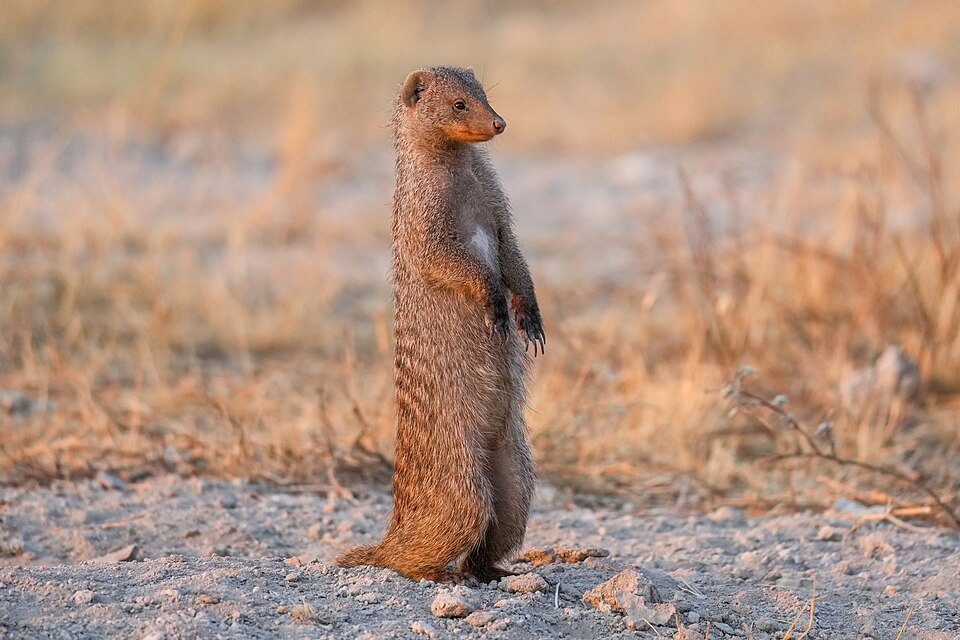
Photo: Giles Laurent · CC BY-SA 4.0 (May be cropped or resized)
Mungos mungo
Conservation status: Unknown
Basic stats
Diet
Mainly beetles and millipedes
Habitat
Savanna, open forest and grassland, especially near water
Range
East, Southeast and South-Central Africa, plus northern West African savannas
Litter size
About 2.5 (AnAge)
Gestation period
60 days
Size
Head-body 30–45cm, tail 15–30cm
Weight
1.5–2.25kg
The banded mongoose is a sturdy mongoose with a large head, small ears, short muscular limbs and a tail nearly as long as its body. Animals from wetter areas are larger and darker than those from drier regions. Its rough grey-brown and black fur bears several dark horizontal bars across the back, with darker limbs and snout and lighter underparts. Long, strong claws allow digging, and the nose varies from grey-brown to orange-red. Adults reach 30–45cm in length and weigh 1.5–2.25kg, with a tail of 15–30cm (Wikipedia, general species account).
It is found across large parts of East, Southeast and South-Central Africa, with populations in northern West African savannas. It occupies savannas, open forest and grassland, especially near water, and is absent from deserts and montane regions, though it also lives in towns and villages (GBIF description, Herpestidae). It uses termite mounds most often for dens, though it also uses rock shelters and thickets, with several entrances. Mixed-sex groups of 5–75, averaging about 20, share a home range, sleep together and move den every two to three days. Dry-area females produce one or two litters annually, while wetter equatorial females may produce as many as five (Wikipedia, general species account; GBIF description, Herpestidae; AnAge).
Where to see Banded Mongoose in Kenya
GBIF records grouped by protected area. They show where the species has been reported, not that it is there now, and they are not population counts.
Recorded in 5 protected areas (1989–2026).
- Masai Mara: 54 records (1989–2026)
- Mara Triangle: 11 records (2000–2025)
- Tsavo East National Park: 8 records (2013–2026)
- Mara North Conservancy: 4 records (2013–2025)
- Tsavo West National Park: 3 records (1989–2015)
Quick answers
- What does the Banded Mongoose eat?
- Mainly beetles and millipedes
- What habitat does the Banded Mongoose live in?
- Savanna, open forest and grassland, especially near water
- Where is the Banded Mongoose found?
- East, Southeast and South-Central Africa, plus northern West African savannas
- What is the litter size of the Banded Mongoose?
- About 2.5 (AnAge)
- How long is the gestation period of the Banded Mongoose?
- 60 days
- How big is the Banded Mongoose?
- Head-body 30–45cm, tail 15–30cm
- How much does the Banded Mongoose weigh?
- 1.5–2.25kg