
 Wildlife
of Kenya
Common Dwarf Mongoose
Hyenas, Mongooses, Civets & Mustelids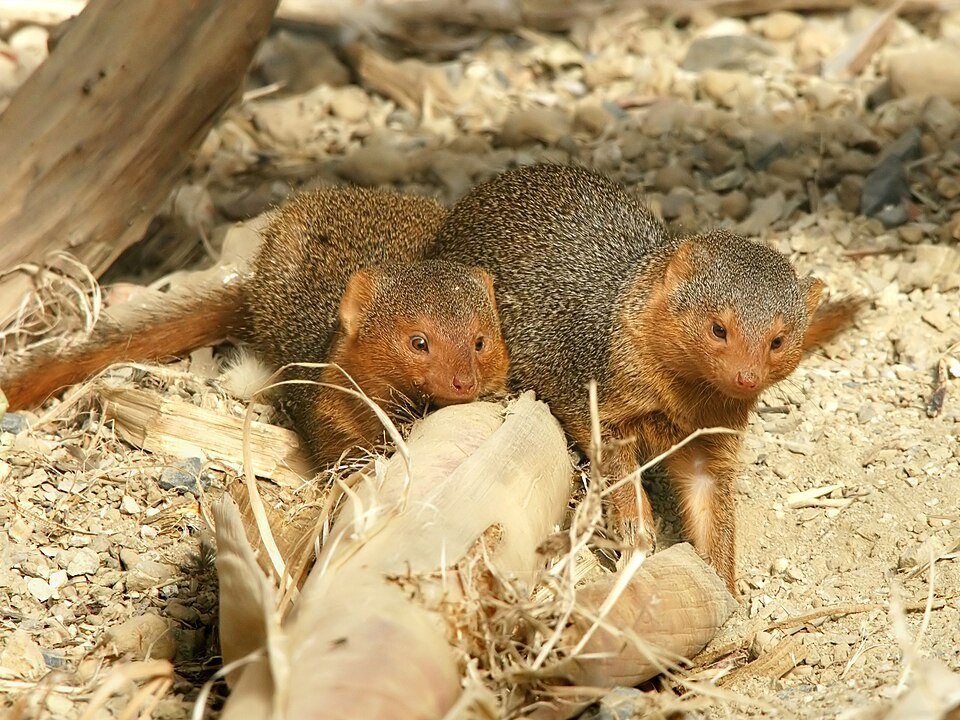
Photo: Hans Hillewaert · CC BY-SA 3.0 (May be cropped or resized)
Helogale parvula
Conservation status: Unknown
Basic stats
Diet
Mostly invertebrates (EltonTraits)
Habitat
Savanna, woodland and dry bush, with termite mounds, up to 2,000m
Range
East and southern Africa, from Eritrea and Ethiopia to northern South Africa
Litter size
About 3
Gestation period
About 55 days (AnAge, COMBINE)
Size
Body 16–23cm
Weight
213–341g
The common dwarf mongoose is Africa's smallest carnivoran, with a body of 16–23cm and a weight of 213–341g. The soft fur ranges from yellowish-red to very dark brown, and the animal has a large pointed head, small ears, a long tail, short limbs and long claws. It is diurnal and highly social, with groups averaging twelve and sometimes over thirty, organised around a single breeding pair in a strict hierarchy where females outrank males of the same age (Wikipedia, general species account).
It lives mainly in dry grassland, open forest and savanna woodland up to 2,000m, and is especially common where there are many termite mounds, its favourite sleeping and denning places. It avoids dense forest and desert. Members of a group feed and rest as a unit within one shared range. It forages with hornbills, which warn of predators. A dominant female can produce up to four litters a year, and gestation is about 55 days (GBIF description, Herpestidae; Wikipedia, general species account; AnAge).
Where to see Common Dwarf Mongoose in Kenya
GBIF records grouped by protected area. They show where the species has been reported, not that it is there now, and they are not population counts.
Recorded in 5 protected areas (1985–2026).
- Masai Mara: 14 records (2003–2026)
- Tsavo East National Park: 6 records (2013–2026)
- Mara Triangle: 6 records (2015–2026)
- Buffalo Springs National Reserve: 3 records (1985–2010)
- Tana Delta Community Conservancy: 3 records
Quick answers
- What does the Common Dwarf Mongoose eat?
- Mostly invertebrates (EltonTraits)
- What habitat does the Common Dwarf Mongoose live in?
- Savanna, woodland and dry bush, with termite mounds, up to 2,000m
- Where is the Common Dwarf Mongoose found?
- East and southern Africa, from Eritrea and Ethiopia to northern South Africa
- What is the litter size of the Common Dwarf Mongoose?
- About 3
- How long is the gestation period of the Common Dwarf Mongoose?
- About 55 days (AnAge, COMBINE)
- How big is the Common Dwarf Mongoose?
- Body 16–23cm
- How much does the Common Dwarf Mongoose weigh?
- 213–341g