
 Wildlife
of Kenya
White-faced Whistling-Duck
Ducks, Geese & Grebes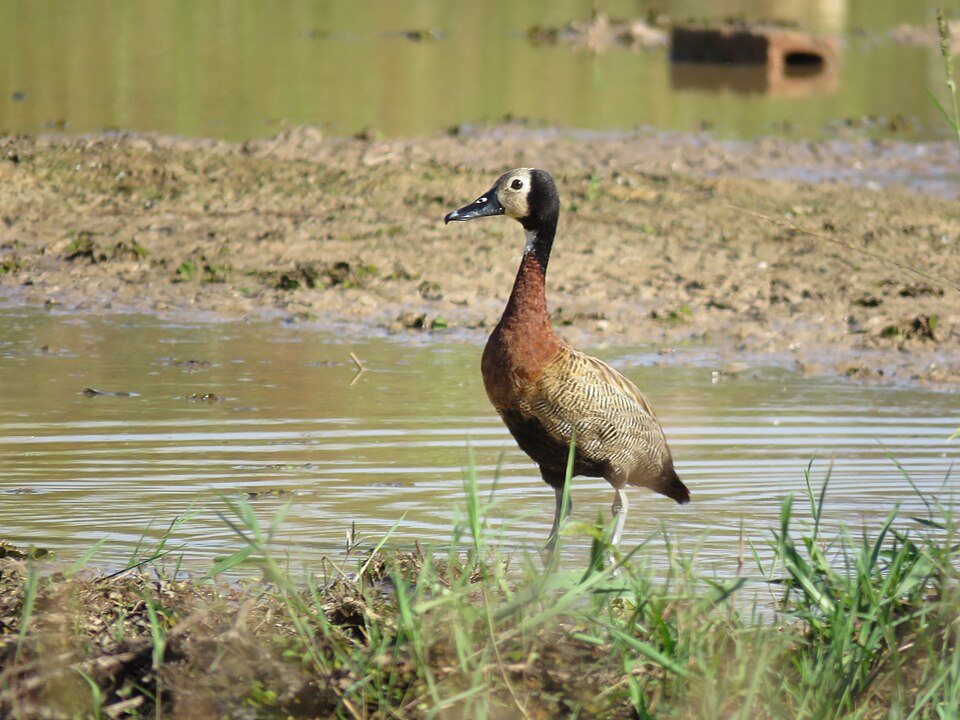
Photo: Vincent Vos Bolivia · CC BY-SA 4.0 (May be cropped or resized)
Dendrocygna viduata
Conservation status: Unknown
Basic stats
Diet
Plant material, invertebrates and seeds
Habitat
Vegetated freshwater lakes, reservoirs and reedbeds
Range
Sub-Saharan Africa and much of South America
Clutch size
Usually 6–12 eggs
Incubation period
26–28 days
Weight
Averages about 690g
The White-faced Whistling-Duck has a white face, black head and neck, chestnut neck base, dark back and finely barred flanks. Its long gray bill, longish legs and clear three-note whistle are distinctive; males and females share similar plumage. AVONET records an average mass of about 690 g and classifies it as a partly migratory aquatic wetland herbivore (Wikipedia, general species account; AVONET, Tobias et al. 2022).
Its range is divided between sub-Saharan Africa and much of South America. Large, noisy flocks use vegetated freshwater lakes and reservoirs, making local movements as water conditions change. Other plant matter forms 40% of the EltonTraits diet profile, invertebrates 30% and seeds 20%. Six to twelve eggs are laid in ground hollows or reedbeds and both sexes incubate them for 26–28 days (Wikipedia, general species account; EltonTraits, Wilman et al. 2014).
Where to see White-faced Whistling-Duck in Kenya
GBIF records grouped by protected area. They show where the species has been reported, not that it is there now, and they are not population counts.
Recorded in 60 protected areas (1966–2026). The 8 with the most records:
- Amboseli National Park: 1,190 records (1973–2026)
- Masai Mara: 818 records (1981–2025)
- Nairobi National Park: 749 records (1978–2024)
- Mara Triangle: 482 records (1981–2024)
- Lake Nakuru National Park: 342 records (1982–2026)
- Arabuko-Sokoke Forest Reserve: 134 records (1983–2024)
- Tsavo East National Park: 101 records (1987–2025)
- Tsavo West National Park: 70 records (1966–2024)
Quick answers
- What does the White-faced Whistling-Duck eat?
- Plant material, invertebrates and seeds
- What habitat does the White-faced Whistling-Duck live in?
- Vegetated freshwater lakes, reservoirs and reedbeds
- Where is the White-faced Whistling-Duck found?
- Sub-Saharan Africa and much of South America
- How many eggs does the White-faced Whistling-Duck lay?
- Usually 6–12 eggs
- How long are the eggs of the White-faced Whistling-Duck incubated?
- 26–28 days
- How much does the White-faced Whistling-Duck weigh?
- Averages about 690g