
 Wildlife
of Kenya
Eared Grebe
Ducks, Geese & Grebes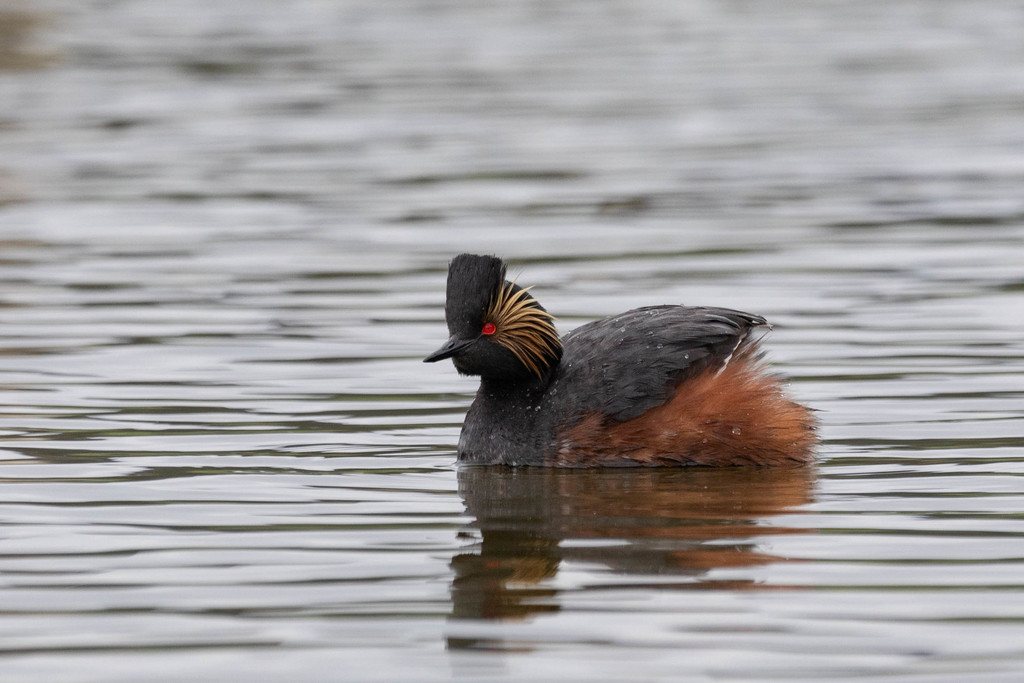
Photo: (c) Kalvin Chan, some rights reserved (CC BY) · CC-BY (May be cropped or resized)
Podiceps nigricollis
Conservation status: Unknown
Basic stats
Diet
Mostly aquatic insects, with crustaceans, molluscs and small vertebrates
Habitat
Open lakes for breeding and saline lakes during moult
Range
Disjunct populations in Eurasia, Africa and the Americas
Clutch size
Usually 3–4 eggs
Incubation period
About 21 days
Size
28–34cm
Wingspan
52–60cm
Weight
Averages about 412g
The Eared Grebe is a small waterbird whose breeding plumage combines a black head, neck and breast with chestnut flanks and fans of ochre feathers behind bright red eyes. Outside the breeding season it becomes grey-black above and white below, retaining a thin, slightly upturned bill. The sexes look similar. Adults measure 28–34 cm, span roughly 52–60 cm and average about 412 g (Wikipedia, general species account; AVONET, Tobias et al. 2022).
Across scattered populations in Eurasia, Africa and the Americas, the species breeds on open lakes, building floating cup nests either alone or in colonies. Three or four eggs are usual and hatch after about 21 days. Aquatic insects dominate the diet; diving also yields crustaceans, molluscs, tadpoles and small fish. Some populations travel thousands of kilometres to saline moulting lakes, where brine shrimp become important. Birds become flightless for at least a month during the concentrated moult (Wikipedia, general species account; EltonTraits, Wilman et al. 2014; AnAge).
Where to see Eared Grebe in Kenya
GBIF records grouped by protected area. They show where the species has been reported, not that it is there now, and they are not population counts.
Recorded in 8 protected areas (1977–2024).
- Lake Bogoria National Reserve: 140 records (1984–2024)
- Lake Nakuru National Park: 106 records (1977–2024)
- Soysambu Conservancy: 17 records (1993–2024)
- Amboseli National Park: 8 records (1991–2021)
- Kwenia Vulture Sanctuary: 6 records (2024)
- Crescent Island Widlife Sanctuary: 5 records (1982–2022)
- Oserongoni Wildlife Sanctuary & Oserian Two Lakes Estate: 5 records (2012–2014)
- Crater Lake Conservancy: 4 records (2016–2017)
Quick answers
- What does the Eared Grebe eat?
- Mostly aquatic insects, with crustaceans, molluscs and small vertebrates
- What habitat does the Eared Grebe live in?
- Open lakes for breeding and saline lakes during moult
- Where is the Eared Grebe found?
- Disjunct populations in Eurasia, Africa and the Americas
- How many eggs does the Eared Grebe lay?
- Usually 3–4 eggs
- How long are the eggs of the Eared Grebe incubated?
- About 21 days
- How big is the Eared Grebe?
- 28–34cm
- What is the wingspan of the Eared Grebe?
- 52–60cm
- How much does the Eared Grebe weigh?
- Averages about 412g