
 Wildlife
of Kenya
Spotted Eagle-Owl
Owls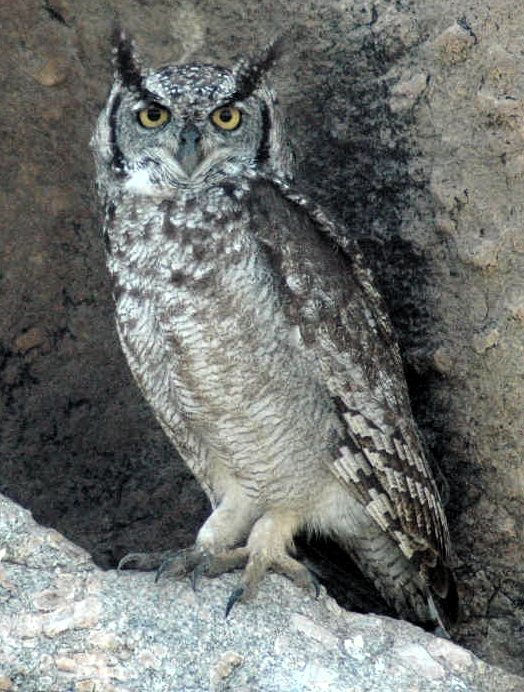
Photo: David Erickson, self, · Public domain
Bubo africanus
Conservation status: Unknown
Basic stats
Diet
Invertebrates, mammals, birds and reptiles
Habitat
Rocky country and open woodland
Range
Sub-Saharan Africa and Arabia
Clutch size
2–4 eggs
Incubation period
About 32 days
Size
About 45cm
Wingspan
About 100–140cm
Weight
About 454–907g
Spotted Eagle-Owls measure about 45 cm, span 100–140 cm and weigh 454–907 g. Prominent ear tufts rise above a pale ochre facial disc and yellow eyes; dusky-brown upperparts contrast with off-white, brown-barred underparts. Males typically give two musical hoots and females answer with three, while alarmed birds hiss, snap their bills and spread their wings in threat displays (Wikipedia, general species account).
Across sub-Saharan Africa and the Arabian Peninsula, Spotted Eagle-Owls inhabit rocky ground, thorn savanna, open woodland and suburban gardens. Nocturnal hunters usually drop from perches, taking large quantities of insects as well as rodents, birds, reptiles, frogs and other prey. Females lay two to four eggs in ground scrapes, cavities or building ledges and incubate for about 32 days. Young leave elevated nests at five weeks and fly at roughly seven weeks (Wikipedia, general species account; EltonTraits, Wilman et al. 2014; Collins Birds of the World).
Where to see Spotted Eagle-Owl in Kenya
GBIF records grouped by protected area. They show where the species has been reported, not that it is there now, and they are not population counts.
Recorded in 23 protected areas (1971–2026). The 8 with the most records:
- Ndara Conservancy: 77 records (2010–2023)
- Tsavo West National Park: 63 records (1971–2026)
- Amboseli National Park: 50 records (1991–2024)
- Lake Nakuru National Park: 48 records (1987–2024)
- Masai Mara: 22 records (1993–2024)
- Hell's Gate National Park: 19 records (1988–2024)
- Soysambu Conservancy: 18 records (1992–2024)
- Nairobi National Park: 17 records (1993–2026)
Quick answers
- What does the Spotted Eagle-Owl eat?
- Invertebrates, mammals, birds and reptiles
- What habitat does the Spotted Eagle-Owl live in?
- Rocky country and open woodland
- Where is the Spotted Eagle-Owl found?
- Sub-Saharan Africa and Arabia
- How many eggs does the Spotted Eagle-Owl lay?
- 2–4 eggs
- How long are the eggs of the Spotted Eagle-Owl incubated?
- About 32 days
- How big is the Spotted Eagle-Owl?
- About 45cm
- What is the wingspan of the Spotted Eagle-Owl?
- About 100–140cm
- How much does the Spotted Eagle-Owl weigh?
- About 454–907g