
 Wildlife
of Kenya
Serval
Cats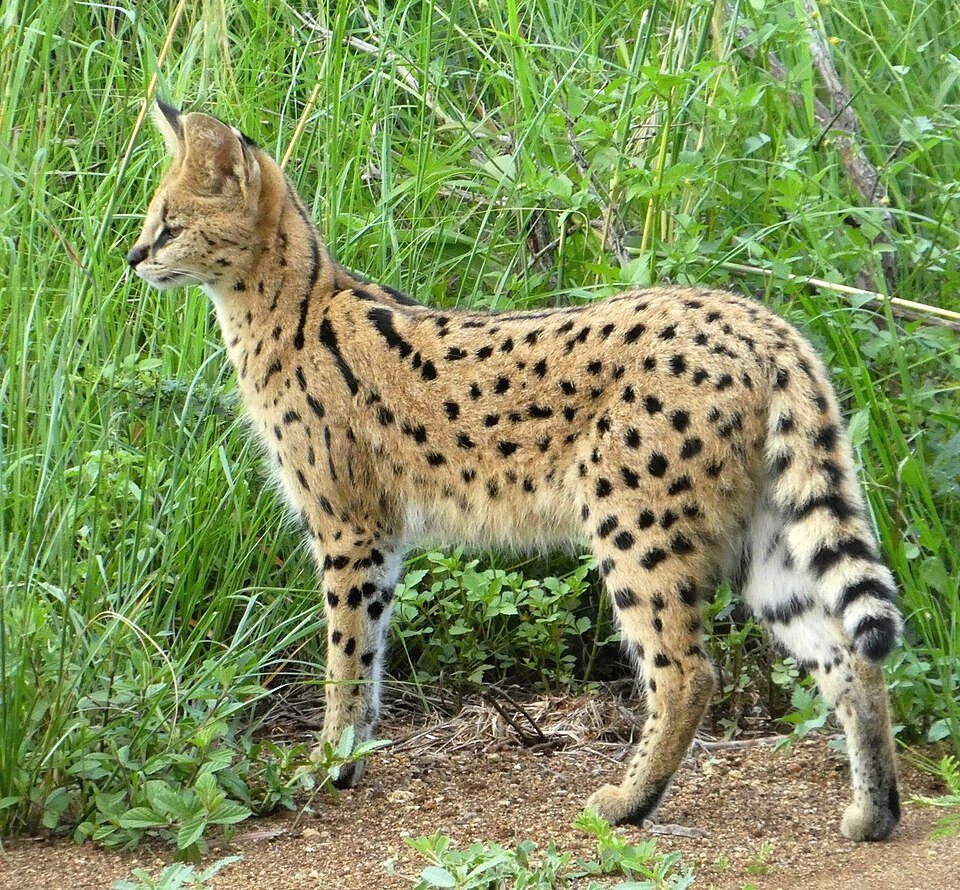
Photo: datadan · CC BY 4.0 (May be cropped or resized)
Leptailurus serval
Conservation status: Unknown
Basic stats
Diet
Rodents, especially vlei rats; also small birds, frogs, insects and reptiles
Habitat
Grassland, savanna, wetlands, reed beds and moorland up to 3,000m
Range
Sub-Saharan Africa
Litter size
1–4, usually 2
Gestation period
About 70–74 days
Size
Shoulder height 54–62cm; head and body 67–100cm; tail about 30cm
Weight
8–18kg
The serval is a slender, medium-sized African cat with a small head, very large ears and a golden-yellow to buff coat marked with black spots and stripes. It stands 54–62cm at the shoulder, measures 67–100cm in head and body length, and weighs 8–18kg, with females lighter. The tail is about 30cm long with a black tip. It has the longest legs of any cat relative to its body size, owing to greatly elongated foot bones. The ears are black on the back with a white band across the middle (Wikipedia, general species account).
The serval inhabits grasslands, savannas, wetlands and moorland to about 3,000m, with its distribution closely tied to water and reed beds. It is solitary and active by day and night, preying on rodents, small birds, frogs, insects and reptiles, and it leaps more than 2m to pounce. Home ranges are 10–32km2. Gestation is about 70–74 days and typically two kittens are born in a den. Young hunt for themselves from about six months old (Wikipedia, general species account; GBIF description, Felidae; AnAge).
Where to see Serval in Kenya
GBIF records grouped by protected area. They show where the species has been reported, not that it is there now, and they are not population counts.
Recorded in 8 protected areas (1989–2026).
- Masai Mara: 16 records (1989–2026)
- Chyulu Hills: 7 records (2015)
- Amboseli National Park: 5 records (2019–2026)
- Tsavo East National Park: 4 records (2016–2026)
- Mara North Conservancy: 4 records (2010–2019)
- Mpala Ranch: 3 records (2011–2019)
- Oloisukut Conservancy: 3 records (2010–2013)
- Taita Hills Wildlife Sanctuary: 3 records (2016–2019)
Quick answers
- What does the Serval eat?
- Rodents, especially vlei rats; also small birds, frogs, insects and reptiles
- What habitat does the Serval live in?
- Grassland, savanna, wetlands, reed beds and moorland up to 3,000m
- Where is the Serval found?
- Sub-Saharan Africa
- What is the litter size of the Serval?
- 1–4, usually 2
- How long is the gestation period of the Serval?
- About 70–74 days
- How big is the Serval?
- Shoulder height 54–62cm; head and body 67–100cm; tail about 30cm
- How much does the Serval weigh?
- 8–18kg