
 Wildlife
of Kenya
Red-billed Duck
Ducks, Geese & Grebes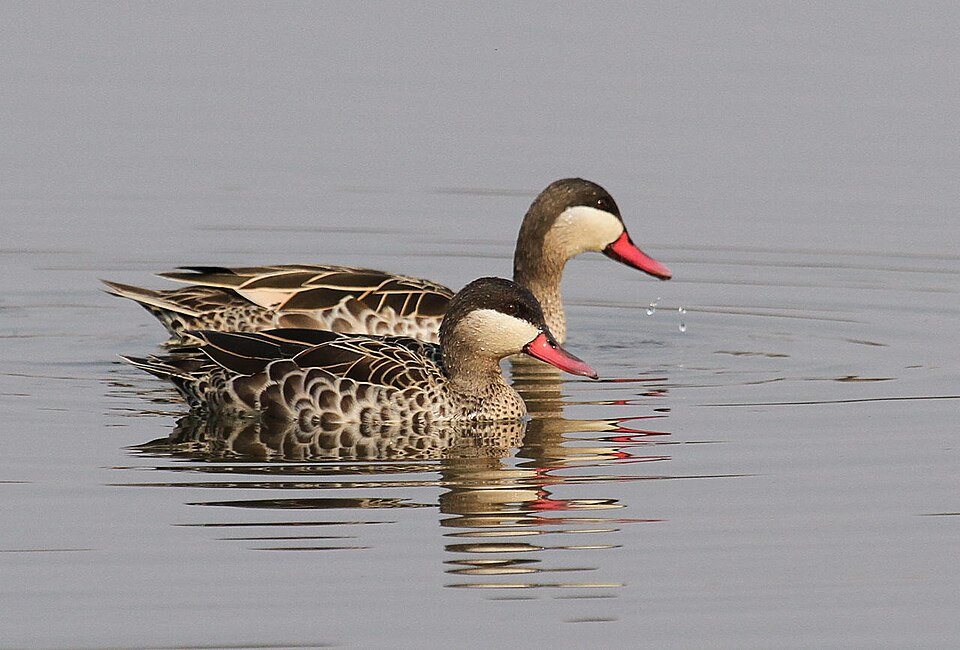
Photo: Derek Keats from Johannesburg, South Africa · CC BY 2.0 (May be cropped or resized)
Anas erythrorhyncha
Conservation status: Unknown
Basic stats
Diet
Aquatic plants, seeds, fruit and invertebrates
Habitat
Freshwater wetlands in open country
Range
Southern and eastern Africa
Size
43–48cm
The Red-billed Duck is a dark, compact dabbling duck with a blackish cap and nape, pale face and bright red bill. Its body is brown with fine scalloping, and the secondary feathers show a buff panel crossed by black. Males and females are similar, although juveniles are duller. It is a resident breeder in southern and eastern Africa (Wikipedia, general species account).
Freshwater habitats in open country provide the main setting. The species feeds by dabbling for aquatic plants and by foraging on land, taking seeds, fruit and some invertebrates, often in the evening or at night. Birds can travel long distances between suitable waters and form large flocks outside breeding. Nests are placed on the ground in dense vegetation near water (EltonTraits, Wilman et al. 2014; Wikipedia, general species account).
Where to see Red-billed Duck in Kenya
GBIF records grouped by protected area. They show where the species has been reported, not that it is there now, and they are not population counts.
Recorded in 58 protected areas (1963–2026). The 8 with the most records:
- Amboseli National Park: 1,187 records (1971–2026)
- Lake Nakuru National Park: 704 records (1969–2026)
- Nairobi National Park: 682 records (1972–2024)
- Ol Pejeta Conservancy: 226 records (1995–2026)
- Masai Mara: 166 records (1971–2024)
- Mpala Ranch: 146 records (2006–2024)
- Lewa Wildlife Conservancy: 112 records (1996–2024)
- Tsavo East National Park: 109 records (1970–2024)
Quick answers
- What does the Red-billed Duck eat?
- Aquatic plants, seeds, fruit and invertebrates
- What habitat does the Red-billed Duck live in?
- Freshwater wetlands in open country
- Where is the Red-billed Duck found?
- Southern and eastern Africa
- How big is the Red-billed Duck?
- 43–48cm