
 Wildlife
of Kenya
Lesser Striped Swallow
Other Songbirds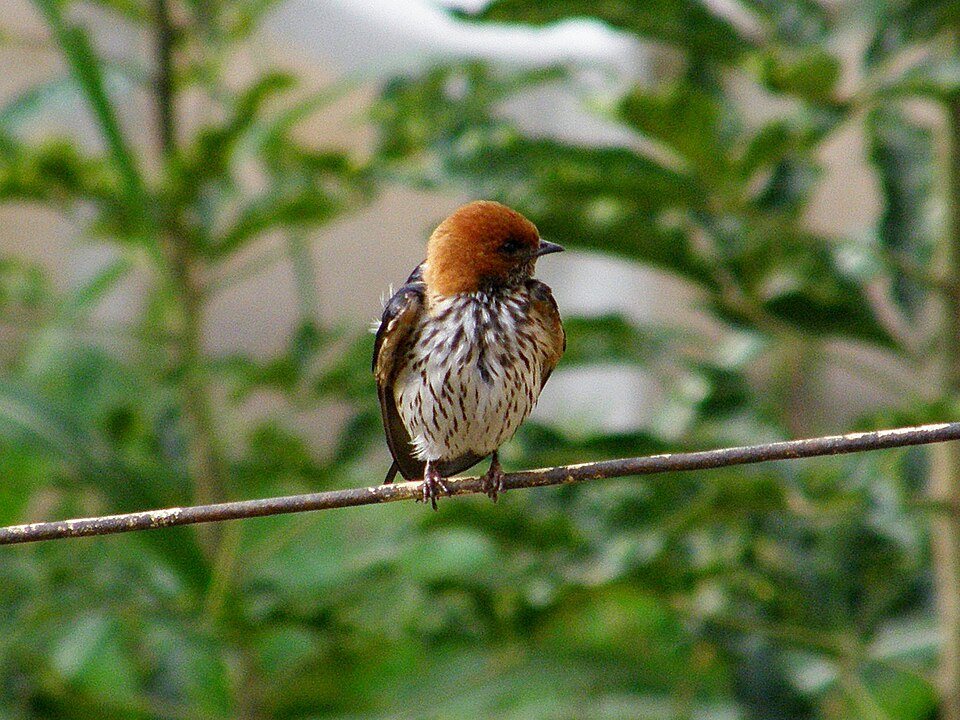
Photo: rmedina · CC BY 4.0 (May be cropped or resized)
Cecropis abyssinica
Conservation status: Unknown
Basic stats
Diet
Mostly flying insects and some fruit
Habitat
Woodland, savanna and villages
Range
Sub-Saharan Africa
Clutch size
Usually 3 eggs
Incubation period
About 14–16 days
Size
About 15–19cm
Weight
Averages about 14g
Lesser Striped Swallows are 15–19 cm long and weigh roughly 14 g. Dark-blue upperparts meet a red rump and rufous-chestnut crown, nape and face, while bold dark streaks cross white underparts. Blackish tails end in elongated outer feathers, slightly longer in males; juveniles are browner and shorter-tailed. Erratic flight mixes fluttering and gliding, and nasal calls accompany a vigorous squeaky song (Wikipedia, general species account; AVONET, Tobias et al. 2022; Collins Birds of the World).
Across sub-Saharan Africa, Lesser Striped Swallows favor lowland woodland, forest edges, savanna, grassland and settlements, with some populations moving after breeding. They catch insects in the air and occasionally take small fruit. Bowl-shaped mud nests with tubular entrances are fixed beneath caves, branches, bridges, buildings or culverts. Females incubate a typical three-egg clutch for 14–16 days, then both parents feed chicks that fledge after another 17–19 days (Wikipedia, general species account; EltonTraits, Wilman et al. 2014).
Where to see Lesser Striped Swallow in Kenya
GBIF records grouped by protected area. They show where the species has been reported, not that it is there now, and they are not population counts.
Recorded in 110 protected areas (1909–2026). The 8 with the most records:
- Masai Mara: 1,863 records (1972–2026)
- Nairobi National Park: 1,348 records (1971–2026)
- Tsavo West National Park: 750 records (1969–2025)
- Amboseli National Park: 707 records (1975–2026)
- Mara Triangle: 641 records (1976–2026)
- Mpala Ranch: 572 records (2000–2026)
- Kagamega Forest: 353 records (1977–2024)
- Tsavo East National Park: 335 records (1973–2026)
Quick answers
- What does the Lesser Striped Swallow eat?
- Mostly flying insects and some fruit
- What habitat does the Lesser Striped Swallow live in?
- Woodland, savanna and villages
- Where is the Lesser Striped Swallow found?
- Sub-Saharan Africa
- How many eggs does the Lesser Striped Swallow lay?
- Usually 3 eggs
- How long are the eggs of the Lesser Striped Swallow incubated?
- About 14–16 days
- How big is the Lesser Striped Swallow?
- About 15–19cm
- How much does the Lesser Striped Swallow weigh?
- Averages about 14g