
 Wildlife
of Kenya
Green Barbet
Barbets & Woodpeckers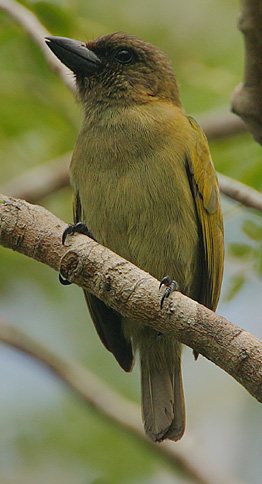
Photo: Steve Garvie from Dunfermline, Fife, Scotland · CC BY-SA 2.0 (May be cropped or resized)
Cryptolybia olivacea
Conservation status: Unknown
Basic stats
Diet
Fruit and invertebrates
Habitat
Forest from sea level to 1,800m
Range
Kenya, Tanzania, Malawi, Mozambique and South Africa
Weight
Average 49g
From South Africa north through Mozambique, Malawi and Tanzania to Kenya, the Green Barbet inhabits forest up to 1,800 metres. Their plumage is subdued ginger-olive, more yellow on the wings and paler underneath. The nominate form has a dark brown head and chin, while the eyes range from dull red to orange. Its dark bill and feet contrast with the duller plumage and brown eyes of juveniles. (Wikipedia, general species account; AVONET, Tobias et al. 2022)
These barbets visit fruiting branches in the forest subcanopy and may forage or roost alone or socially. Wild figs may be an especially important food source. Their repetitive call is rendered as a series of chock or chop notes, and pairs sometimes call in duet. They nest in cavities in tree trunks, with breeding reported in midsummer. They eat fruit and invertebrates. (Wikipedia, general species account; EltonTraits, Wilman et al. 2014)
Where to see Green Barbet in Kenya
GBIF records grouped by protected area. They show where the species has been reported, not that it is there now, and they are not population counts.
Recorded in 5 protected areas (1962–2024).
- Arabuko-Sokoke Forest Reserve: 1,291 records (1962–2024)
- Shimba Hills National Reserve: 368 records (1972–2024)
- Watamu Marine National Park: 21 records (1990–2024)
- Diani-Chale Marine Reserve: 7 records (1989–2024)
- Proposed Friends of Nature (front) Conservancy: 6 records (1982–1985)
Quick answers
- What does the Green Barbet eat?
- Fruit and invertebrates
- What habitat does the Green Barbet live in?
- Forest from sea level to 1,800m
- Where is the Green Barbet found?
- Kenya, Tanzania, Malawi, Mozambique and South Africa
- How much does the Green Barbet weigh?
- Average 49g