
 Wildlife
of Kenya
Black Crake
Cranes, Rails & Bustards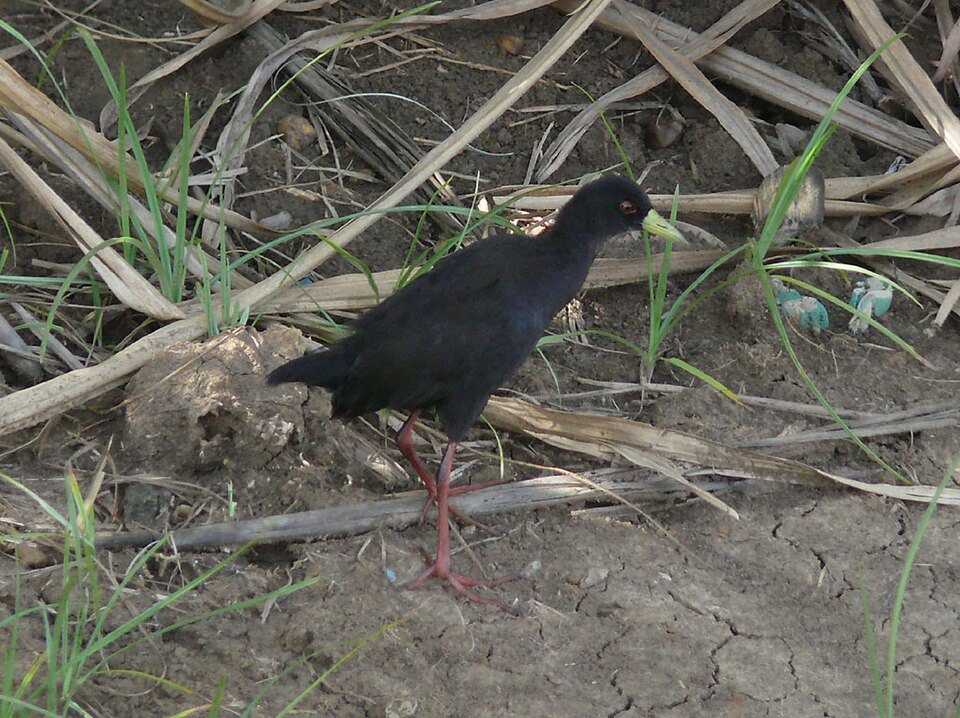
Photo: ChriKo · CC BY-SA 3.0 (May be cropped or resized)
Zapornia flavirostra
Conservation status: Unknown
Black Crake breeds across most of sub-Saharan Africa, avoiding the driest regions. In areas affected by drought, birds make seasonal movements as wetlands change. It inhabits marshes and other wet places, often feeding along the edges of open water and vegetation. At 19–23 cm, the bird has lengthened toes and a stubby tail suited to walking through shallow water and wet ground. (Wikipedia, general species account; Collins Birds of the World; AVONET, Tobias et al. 2022; EltonTraits, Wilman et al. 2014)
Adults are mainly black, with a subtle brown-olive cast on the upperparts and wings. The eye is red, the bill yellow and the legs red, though these colors may become duller outside breeding. The sexes look alike, but males are slightly larger and often have a hooked upper bill. Young birds are browner above, with dark gray head and underparts. It forages for small animals and plant material in marsh vegetation. (Wikipedia, general species account; Collins Birds of the World; AVONET, Tobias et al. 2022; EltonTraits, Wilman et al. 2014)
Where to see Black Crake in Kenya
GBIF records grouped by protected area. They show where the species has been reported, not that it is there now, and they are not population counts.
Recorded in 63 protected areas (1965–2026). The 8 with the most records:
- Nairobi National Park: 1,372 records (1966–2024)
- Masai Mara: 859 records (1981–2026)
- Amboseli National Park: 755 records (1973–2026)
- Mara Triangle: 329 records (1981–2024)
- Tsavo West National Park: 284 records (1970–2024)
- Lake Nakuru National Park: 228 records (1969–2026)
- Crescent Island Widlife Sanctuary: 183 records (1973–2024)
- Buffalo Springs National Reserve: 110 records (1979–2024)