
 Wildlife
of Kenya
Arrow-marked Babbler
Other Songbirds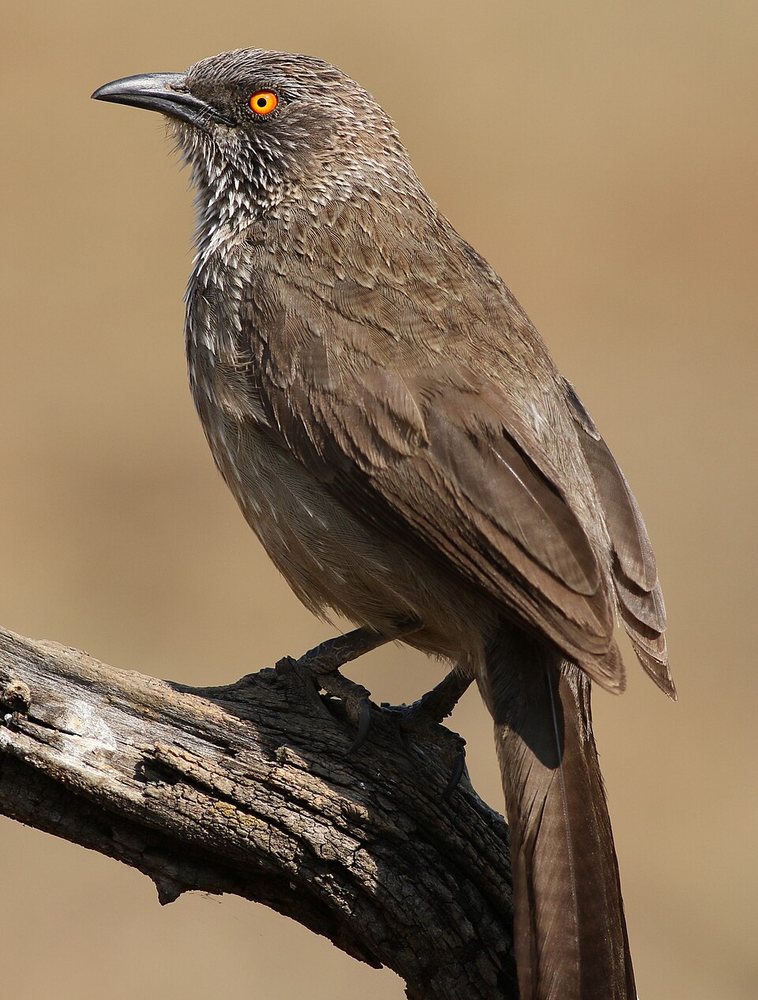
Photo: Derek Keats from Johannesburg, South Africa · CC BY 2.0 (May be cropped or resized)
Turdoides jardineii
Conservation status: Unknown
Basic stats
Diet
Insects, spiders, snails, lizards and fruit
Habitat
Dry forest, savanna and moist shrubland
Range
Southern Afrotropics
Size
22–25cm
Weight
56–85g
Arrow-marked Babbler is native to southern African woodlands and occurs across much of the southern Afrotropics. Adults measure 22–25 cm and weigh 56–85 g. Brownish-grey upperparts contrast with paler underparts, while white feather tips create arrow-like streaks on the head, neck and throat. The sexes look alike; juveniles have brown eyes and less sharply formed breast markings. (Wikipedia, general species account)
Groups contain about three to fifteen birds, averaging six, and defend territories whose size varies with group size. They forage close to the ground, sometimes alongside other babblers or bulbuls. Food includes insects, spiders, occasional snails and lizards, as well as fruit. A red border surrounds the iris, which is yellow or orange at its center. (Wikipedia, general species account)
Where to see Arrow-marked Babbler in Kenya
GBIF records grouped by protected area. They show where the species has been reported, not that it is there now, and they are not population counts.
Recorded in 33 protected areas (1973–2026). The 8 with the most records:
- Masai Mara: 1,123 records (1978–2026)
- Lake Nakuru National Park: 794 records (1973–2024)
- Mara Triangle: 447 records (1981–2026)
- Soysambu Conservancy: 182 records (1992–2024)
- Crater Lake Conservancy: 83 records (1981–2026)
- Naboisho Conservancy: 62 records (2009–2024)
- Oserongoni Wildlife Sanctuary & Oserian Two Lakes Estate: 62 records (2001–2024)
- Green Park Wildlife Estate: 54 records (1996–2024)
Quick answers
- What does the Arrow-marked Babbler eat?
- Insects, spiders, snails, lizards and fruit
- What habitat does the Arrow-marked Babbler live in?
- Dry forest, savanna and moist shrubland
- Where is the Arrow-marked Babbler found?
- Southern Afrotropics
- How big is the Arrow-marked Babbler?
- 22–25cm
- How much does the Arrow-marked Babbler weigh?
- 56–85g