
 Wildlife
of Kenya
Black-crowned Tchagra
Other Songbirds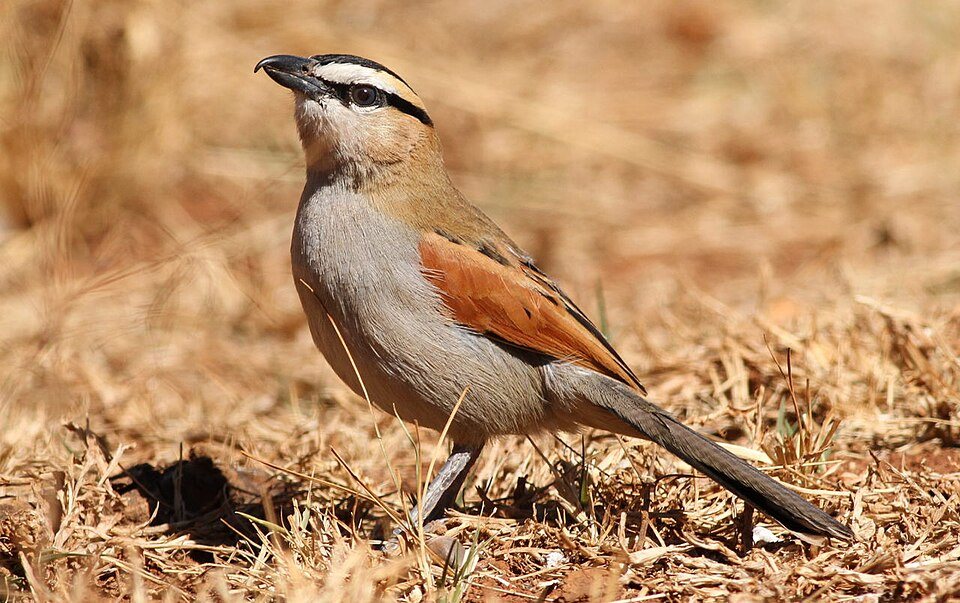
Photo: Derek Keats (https://www.flickr.com/photos/dkeats ) · CC BY 2.0 (May be cropped or resized)
Tchagra senegalus
Conservation status: Unknown
Basic stats
Diet
Insects and other small prey
Habitat
Scrub, open woodland and semi-desert
Range
Africa and Arabian Peninsula
Clutch size
2–3 eggs
Incubation period
12–15 days
Size
19–22cm
Black-crowned Tchagras occur across most of Africa and the Arabian Peninsula, using scrub, open woodland, semi-desert and cultivated land. Adults measure 19–22 cm. The black crown and eye stripe are separated by a broad white eyebrow; pale grey underparts contrast with pale brown upperparts. The folded wings are chestnut, and the black tail has a white tip. The sexes are similar, while young birds have a brown cap. (Wikipedia, general species account)
Tchagras hunt insects and other small prey from a perch, using a less exposed position than true shrikes. Their descending whistle may draw the bird into view, and males perform a switchback display flight. Nests are cups placed in trees or bushes. A clutch contains two or three heavily marked white eggs; both sexes incubate for 12–15 days, chiefly the female, and chicks fledge about 15 days after hatching. (Wikipedia, general species account)
Where to see Black-crowned Tchagra in Kenya
GBIF records grouped by protected area. They show where the species has been reported, not that it is there now, and they are not population counts.
Recorded in 76 protected areas (1965–2024). The 8 with the most records:
- Watamu Marine National Park: 377 records (1973–2024)
- Arabuko-Sokoke Forest Reserve: 356 records (1981–2024)
- Masai Mara: 277 records (1976–2024)
- Masai Moran Conservancy: 198 records (1989–2024)
- Lewa Wildlife Conservancy: 159 records (1965–2024)
- Lake Nakuru National Park: 122 records (1973–2024)
- Tsavo West National Park: 120 records (1969–2024)
- Mara Triangle: 109 records (1976–2024)
Quick answers
- What does the Black-crowned Tchagra eat?
- Insects and other small prey
- What habitat does the Black-crowned Tchagra live in?
- Scrub, open woodland and semi-desert
- Where is the Black-crowned Tchagra found?
- Africa and Arabian Peninsula
- How many eggs does the Black-crowned Tchagra lay?
- 2–3 eggs
- How long are the eggs of the Black-crowned Tchagra incubated?
- 12–15 days
- How big is the Black-crowned Tchagra?
- 19–22cm