
 Wildlife
of Kenya
Arabian Bustard
Cranes, Rails & Bustards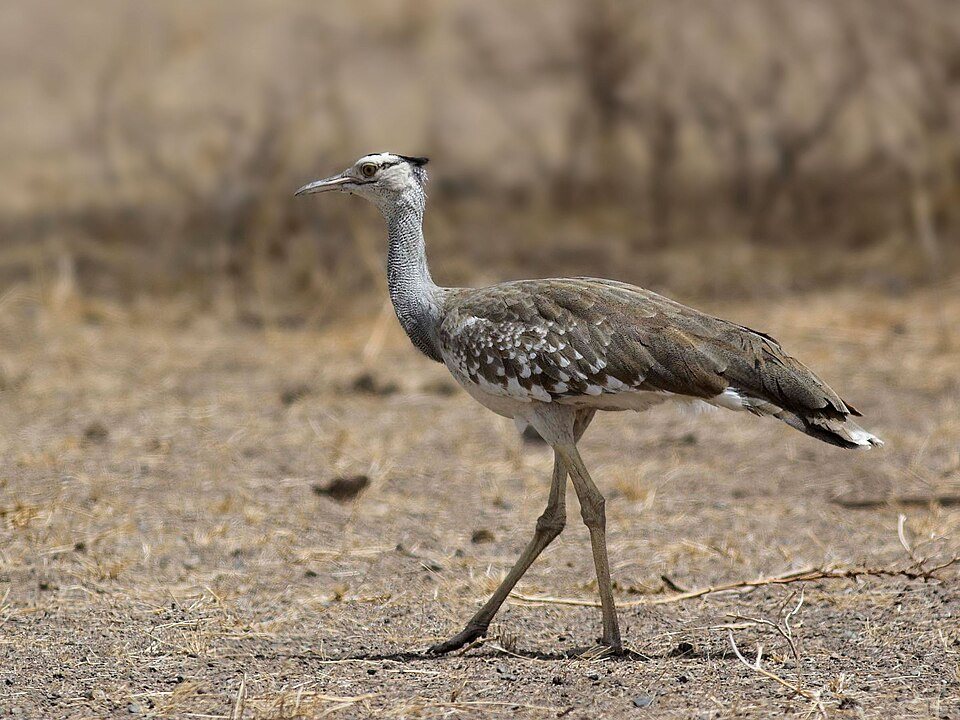
Photo: Allan Drewitt · CC BY 2.0 (May be cropped or resized)
Ardeotis arabs
Conservation status: Unknown
Basic stats
Diet
Invertebrates, fruit, seeds and plant matter
Habitat
Semi-desert, dry grassland and arid scrub
Range
The African Sahel and southwestern Arabia
Clutch size
1–2 eggs
Weight
Averages about 5944g
Arabian Bustards are large ground birds, with males about 100 cm tall and females near 75 cm. In flight, their black flight feathers show faint grey-white barring. Displaying males spread and cock the tail, droop the wings and puff the neck feathers while giving repeated low notes. Average mass is about 5,944 g, and food includes invertebrates, fruit, seeds and other vegetation (AVONET, Tobias et al. 2022; EltonTraits, Wilman et al. 2014; Collins Birds of the World).
Across the African Sahel and southwestern Arabia, Arabian Bustards occupy semi-desert, arid grassland, Acacia woodland and cultivated country. Birds usually travel alone, in pairs or as family groups, though small flocks move north with the rains to breed and return south in the dry season. Females alone incubate one or two eggs in shallow ground scrapes and may distract predators by calling and refusing to flee from threatened chicks (Wikipedia, general species account).
Quick answers
- What does the Arabian Bustard eat?
- Invertebrates, fruit, seeds and plant matter
- What habitat does the Arabian Bustard live in?
- Semi-desert, dry grassland and arid scrub
- Where is the Arabian Bustard found?
- The African Sahel and southwestern Arabia
- How many eggs does the Arabian Bustard lay?
- 1–2 eggs
- How much does the Arabian Bustard weigh?
- Averages about 5944g