
 Wildlife
of Kenya
African Firefinch
Weavers, Waxbills & Whydahs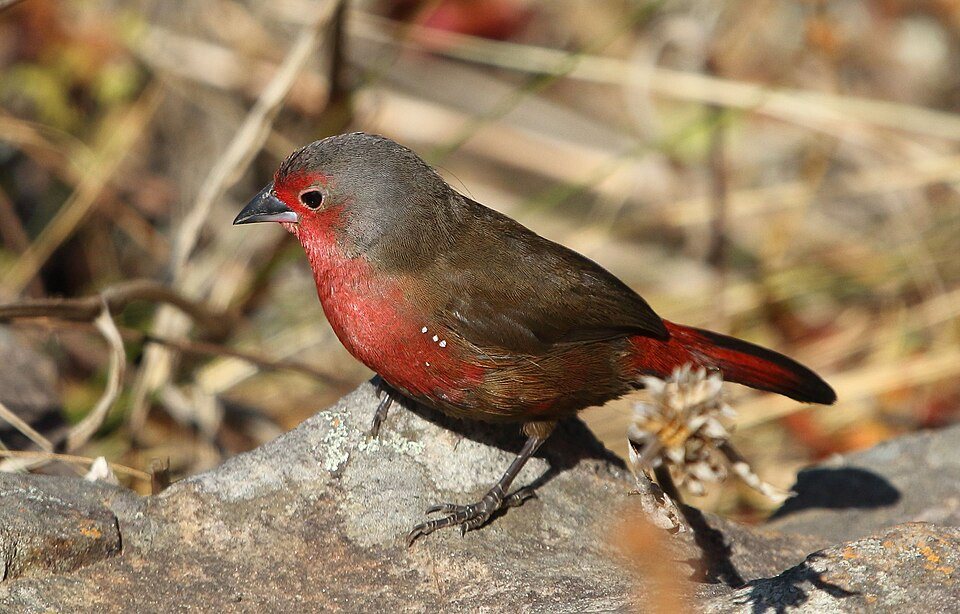
Photo: Alandmanson · CC BY-SA 4.0 (May be cropped or resized)
Lagonosticta rubricata
Conservation status: Unknown
Basic stats
Habitat
Dense vegetation, forest edges, woodland, grass and thornbush
Range
Patches across sub-Saharan Africa
Size
10–11cm
Weight
8.6–11.7g
The African Firefinch, also called the Blue-billed Firefinch, occurs in scattered areas from Senegal east to Ethiopia and south through central and eastern Africa to South Africa. It favors thick vegetation, including forest-edge bracken, acacia woodland, rank grass and thornbush, often beside streams or paths. (Wikipedia, general species account; Collins Birds of the World)
Males have a gray crown and neck, olive-brown mantle, carmine rump and tail coverts, and scarlet underparts with small white spots. Females are less intensely colored, while juveniles lack red below. It feeds mainly on seeds and supplements these with insects, foraging on the ground. A round, side-entrance nest is hidden in dense grass, and the clutch contains two to five eggs. (Wikipedia, general species account)
Where to see African Firefinch in Kenya
GBIF records grouped by protected area. They show where the species has been reported, not that it is there now, and they are not population counts.
Recorded in 35 protected areas (1969–2026). The 8 with the most records:
- Nairobi National Park: 322 records (1970–2025)
- Lake Nakuru National Park: 135 records (1969–2024)
- Ol Pejeta Conservancy: 79 records (1989–2024)
- Lewa Wildlife Conservancy: 58 records (1994–2024)
- Mount Kenya National Reserve: 40 records (1986–2024)
- Soysambu Conservancy: 33 records (1999–2024)
- Kagamega Forest: 30 records (1972–2024)
- Borana Conservancy: 18 records (1998–2024)
Quick answers
- What habitat does the African Firefinch live in?
- Dense vegetation, forest edges, woodland, grass and thornbush
- Where is the African Firefinch found?
- Patches across sub-Saharan Africa
- How big is the African Firefinch?
- 10–11cm
- How much does the African Firefinch weigh?
- 8.6–11.7g