
 Wildlife
of Kenya
White-tailed Mongoose
Hyenas, Mongooses, Civets & Mustelids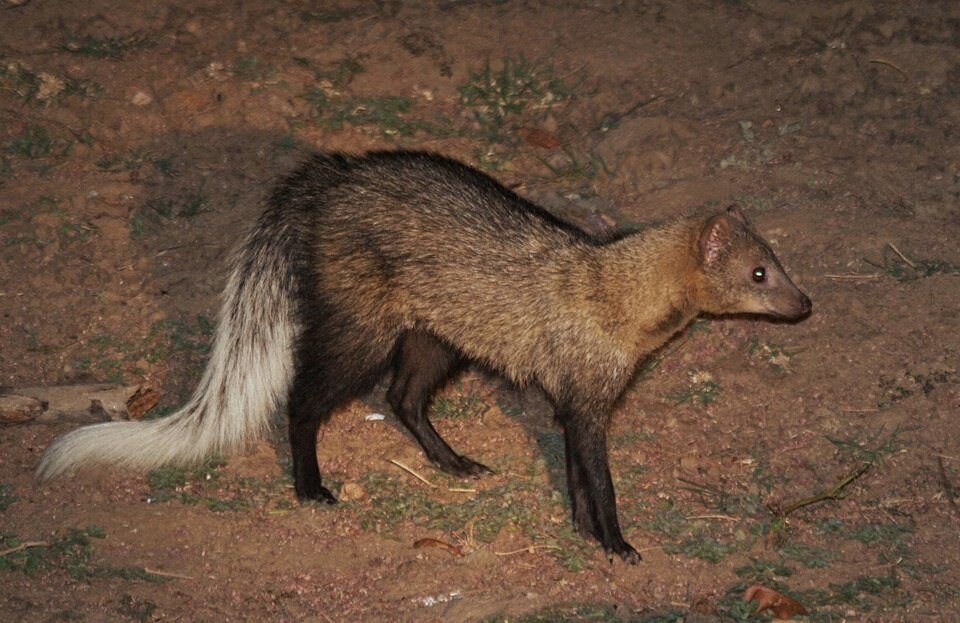
Photo: MCSchaeffer · CC BY-SA 3.0 (May be cropped or resized)
Ichneumia albicauda
Conservation status: Unknown
Basic stats
Diet
Mainly invertebrates (EltonTraits)
Habitat
Grassland, woodland and farmland; not swamp, rainforest or desert
Range
Africa south of the Sahara and southern Arabia
Litter size
About 2.3 (AnAge, COMBINE)
Size
Head and body 53–71cm; tail 40–47cm
Weight
1.8–5.2kg, averaging about 3.4kg
The white-tailed mongoose is probably the longest and heaviest mongoose. The head and body measure 53–71cm and the tail 40–47cm. Weight is 1.8–5.2kg, averaging about 3.4kg. The coat is yellow to tan with long black guard hairs, giving a grizzled gray look, and the legs are black and relatively long. The large bushy tail is brownish-yellow at the base and white on the distal half. The head is long and narrow and the ears large and rounded (Wikipedia, general species account).
It lives across most of Africa south of the Sahara and the southern Arabian Peninsula in grassland, woodland and farmland, preferring thick cover such as forest edges and brushy streams, and avoids swamp, tropical rainforest, desert, and elevations above 4,000m. It is mainly nocturnal and solitary, resting by day in burrows or termite mounds. In Tanzania, male home ranges averaged 0.97km2 and female 0.64km2. It barks and releases a noxious anal secretion in defence (GBIF description, Herpestidae; Wikipedia, general species account).
Where to see White-tailed Mongoose in Kenya
GBIF records grouped by protected area. They show where the species has been reported, not that it is there now, and they are not population counts.
Recorded in 4 protected areas (1914–2025).
- Kirisa-Nkoteiya Conservancy: 4 records (1914–1962)
- Soysambu Conservancy: 4 records (1968–2024)
- Mpala Ranch: 3 records (2015–2023)
- Samburu National Reserve: 3 records (1985–2025)
Quick answers
- What does the White-tailed Mongoose eat?
- Mainly invertebrates (EltonTraits)
- What habitat does the White-tailed Mongoose live in?
- Grassland, woodland and farmland; not swamp, rainforest or desert
- Where is the White-tailed Mongoose found?
- Africa south of the Sahara and southern Arabia
- What is the litter size of the White-tailed Mongoose?
- About 2.3 (AnAge, COMBINE)
- How big is the White-tailed Mongoose?
- Head and body 53–71cm; tail 40–47cm
- How much does the White-tailed Mongoose weigh?
- 1.8–5.2kg, averaging about 3.4kg