
 Wildlife
of Kenya
Zorilla
Hyenas, Mongooses, Civets & Mustelids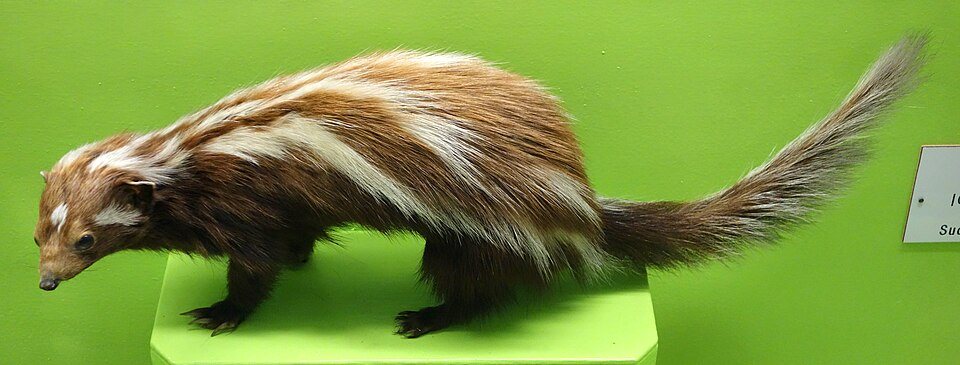
Photo: Daderot · CC0
Ictonyx striatus
Conservation status: Unknown
Basic stats
Diet
Mainly insects and small rodents; also birds, eggs, reptiles, amphibians and other invertebrates
Habitat
Wide range, from mountains and sand plains to forest, swamps, grassland and town gardens
Range
Sub-Saharan Africa, absent from West and Central African rainforests
Litter size
2–3 young
Gestation period
36 days
Size
Head and body 28–38cm; tail 16.5–28cm
Weight
0.7–1.4kg
The zorilla, or striped polecat, is a mustelid of sub-Saharan Africa that resembles a skunk but belongs to a different family. The coat is black with four white stripes down the back that unite on the top of the neck, plus three white patches on the head, and the tail is a mix of black and white hairs. Head and body measure 28–38cm in males and 28–34cm in females, the tail 16.5–28cm, and weight is 0.7–1.4kg, with males about 50% heavier than females. The long curved foreclaws are used for digging (GBIF description, Mustelidae; Wikipedia, general species account).
Zorillas are nocturnal and solitary, resting in holes, crevices, hollow logs or under buildings, often in burrows dug by other animals. They live in a wide range of habitats, from mountains and sand plains to forest, swamps, grassland and town gardens, from Mauritania and Senegal east to Sudan, Ethiopia and Djibouti and south to South Africa. The diet is mainly insects and small rodents. Gestation is 36 days and litters are two or three young, whose eyes open after about 40 days (GBIF description, Mustelidae).
Quick answers
- What does the Zorilla eat?
- Mainly insects and small rodents; also birds, eggs, reptiles, amphibians and other invertebrates
- What habitat does the Zorilla live in?
- Wide range, from mountains and sand plains to forest, swamps, grassland and town gardens
- Where is the Zorilla found?
- Sub-Saharan Africa, absent from West and Central African rainforests
- What is the litter size of the Zorilla?
- 2–3 young
- How long is the gestation period of the Zorilla?
- 36 days
- How big is the Zorilla?
- Head and body 28–38cm; tail 16.5–28cm
- How much does the Zorilla weigh?
- 0.7–1.4kg